
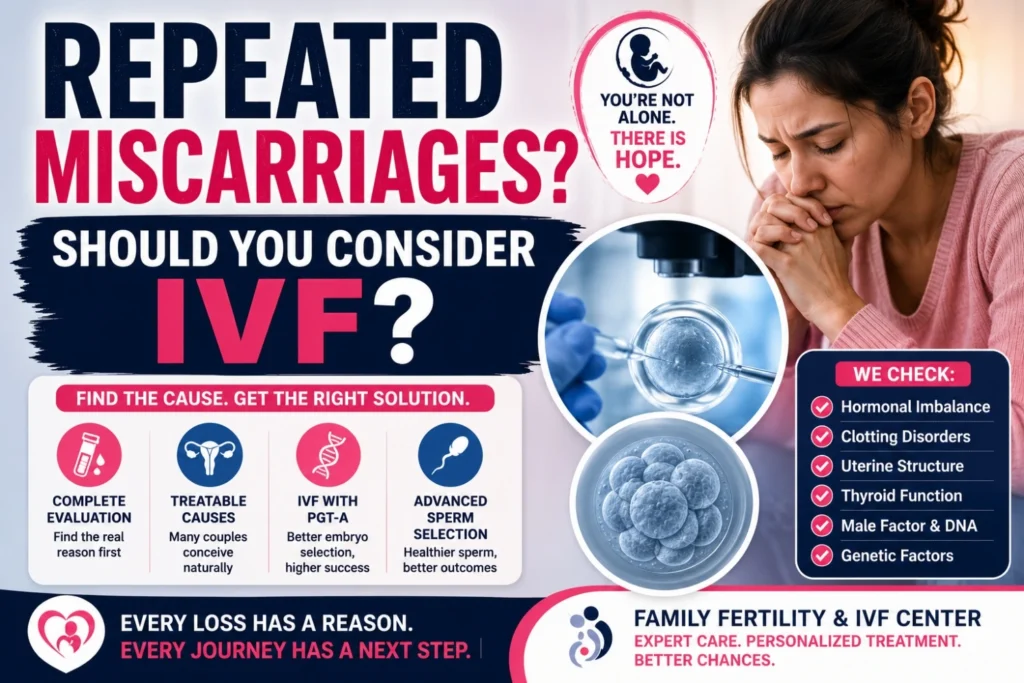
Losing a pregnancy once is devastating. Losing multiple pregnancies in a row is something else entirely.
If this is you, you’ve probably already heard the word “IVF” thrown around. Maybe a friend suggested it. Maybe you searched it late at night, unable to sleep.
Here’s the honest answer. IVF isn’t always the right next step. Sometimes it isn’t even necessary.
The First Step Isn’t IVF
Before anyone talks about IVF, there’s a more basic question to answer. Why is this happening?
Most couples with recurrent pregnancy loss don’t actually need IVF. What they need is a proper medical workup.
This means blood tests for the woman. An ultrasound to check the uterus. And yes, tests for the husband too. Male factors get overlooked far too often.
Dr. Sophia Umair Bajwa emphasizes this point strongly. Skipping straight to IVF without this workup means you might miss a simple, treatable cause.
What Your Fertility Evaluation May Uncover
Sometimes it’s a hormonal imbalance. Sometimes it’s a clotting disorder. Sometimes it’s a structural issue in the uterus, like a septum or fibroid.
Many of these causes are treatable. Once treated, a lot of couples go on to conceive naturally. No IVF required.
This is why patience during diagnosis matters so much. Rushing to treatment without understanding the cause rarely solves the real problem.
So When Does IVF Make Sense?
For some couples, IVF isn’t just an option. It’s genuinely the better path.
This usually applies to a smaller group of patients where advanced lab techniques offer something a natural cycle simply can’t.
PGT-A Testing
This is one of the biggest reasons IVF gets recommended for recurrent loss.
PGT-A checks all 24 chromosomes in an embryo before transfer. It identifies embryos with chromosomal abnormalities, which are one of the most common causes of miscarriage.
By selecting only chromosomally normal embryos for transfer, the chances of another miscarriage drop significantly.
Advanced Sperm Selection
If male factor issues are part of the picture, IVF labs can use specialized sperm selection techniques during ICSI.
This means choosing sperm not just by shape and movement, but by DNA integrity too. Better sperm quality often means better embryo quality, which means fewer pregnancy losses.
IVF Isn’t the Right Answer for Every Couple
Here’s the part that surprises a lot of people. IVF, even with PGT-A, isn’t a guaranteed solution for everyone.
It’s a powerful tool for specific situations. It isn’t a blanket answer for recurrent miscarriage.
Most couples, once the actual cause is identified and treated, don’t end up needing it at all.
Other Possible Causes Your Doctor May Check
Before jumping to any conclusion, a full workup usually checks several other possibilities too.
Thyroid function plays a bigger role in pregnancy loss than most people expect. An underactive or overactive thyroid can quietly disrupt a pregnancy.
Uterine shape matters as well. A septum, or a uterus with an unusual structure, can prevent an embryo from implanting securely, even when everything else is fine.
Blood clotting disorders, sometimes called thrombophilias, can also interfere with how a pregnancy develops in its earliest weeks.
Each of these has its own treatment path, often much simpler than IVF.
The Male Side of the Equation
It’s worth repeating. Recurrent miscarriage isn’t only a female issue.
Sperm DNA fragmentation, meaning damage to the genetic material inside sperm, is linked to higher miscarriage rates. This gets missed constantly because a standard semen analysis doesn’t check for it.
If a couple has had multiple losses and the woman’s tests all come back normal, it’s worth insisting on a more detailed male evaluation.
What This Means for You
If you’ve experienced repeated losses, don’t panic and don’t assume IVF is your only option.
Start with the basics. Push for a thorough workup, for both partners. Ask specific questions about what tests were run and what they showed.
If your results point toward a genetic or male-factor cause, that’s when IVF with PGT-A or advanced sperm selection genuinely earns its place in your treatment plan.
Questions Worth Asking Your Doctor
Has my clotting profile been checked?
Has my partner had a semen analysis with DNA fragmentation testing?
Has my uterine cavity been evaluated properly, not just a quick scan?
If IVF is recommended, why specifically, and what will it change for my case?
A good doctor will have clear answers, not vague reassurance.
Age and Repeated Loss
Age deserves its own mention here, separate from everything else.
As women get older, the rate of chromosomal abnormalities in eggs rises. This is one of the most common reasons behind pregnancy loss in women over 35.
For younger women experiencing repeated miscarriage, doctors often look harder for a structural, hormonal, or immune cause, since age-related chromosomal issues are less likely to be the main driver.
For women closer to or past 35, PGT-A becomes a more relevant conversation earlier on, simply because the odds shift with age.
How Many Miscarriages Count as Recurrent Pregnancy Loss?
Clinically, recurrent pregnancy loss is usually defined as two or more consecutive miscarriages. Some doctors wait until three before starting a full workup, though this is shifting.
If you’ve had two losses in a row, it’s reasonable to ask for testing now rather than waiting for a third. There’s no harm in starting the investigation early.
The Emotional Weight of Repeated Loss
This part deserves its own space. Recurrent miscarriage carries a grief that’s hard to explain to people who haven’t experienced it.
Each loss reopens the same wound. It’s exhausting, physically and emotionally.
Give yourself grace here. Seeking support, whether from a therapist, a support group, or simply your partner, isn’t optional extra credit. It’s part of getting through this well.
How Long Should the Workup Take?
Patience matters here, even though waiting feels unbearable after loss.
A thorough workup usually takes a few weeks, sometimes closer to a full cycle, depending on which tests are needed.
Rushing this stage to “just try again quickly” often means missing the actual cause. That’s a frustrating cycle to repeat, both emotionally and financially.
What a Good First Appointment Looks Like
When you sit down for your initial consultation, a thorough doctor will ask about your full history, not just your most recent loss.
They’ll want to know how many weeks each pregnancy lasted. Whether there were any warning signs beforehand. Whether you’ve had any prior surgeries or infections.
They’ll order bloodwork for both partners, not just one. And they’ll explain, clearly, what each test is checking for and why.
If your consultation skips most of these questions and moves straight to treatment options, that’s worth noticing.
Finding the Right Team
This journey depends heavily on having a doctor who investigates thoroughly before recommending treatment, rather than defaulting straight to IVF because it sounds like the strongest option.
Dr. Sophia Umair Bajwa covers this exact distinction in detail on her YouTube channel, breaking down which cases genuinely need IVF and which ones simply need the right diagnostic workup.
For couples navigating recurrent loss and looking for a team that investigates before recommending IVF, Family Fertility & IVF Center in Lahore focuses on exactly this kind of thorough, step-by-step evaluation.
If you’ve been through this and have questions, or thoughts to add, drop a comment here or on the related YouTube video. We’ll dive into it together.