
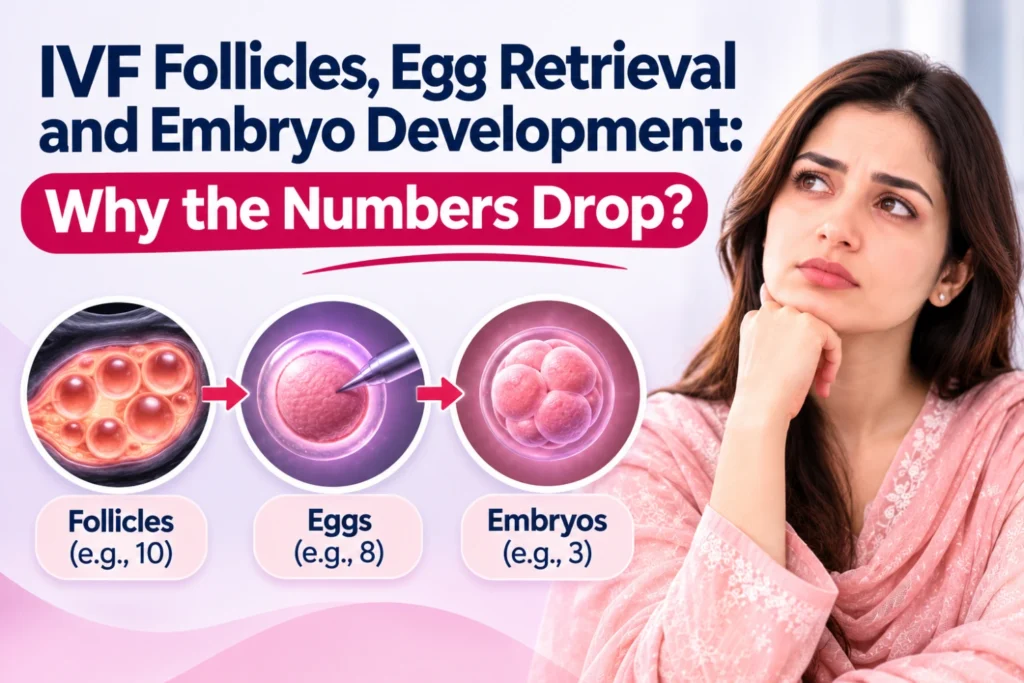
Ten follicles on the scan. Eight eggs on retrieval day. Three embryos on the freezing day. If those numbers worry you, you’re not alone, because almost every IVF patient watches a version of this drop. The figures are an example, but the pattern is real. Understanding why it happens can spare you a lot of unnecessary fear.
Follicles Are Not the Same as Eggs
A follicle is a small fluid-filled sac in the ovary. It can hold an egg, but not every follicle does. Some are empty, and others contain immature or abnormal eggs. So the egg count on retrieval day almost always falls below the follicle count.
What Happens on Retrieval Day
We collect eggs from your follicles with a fine needle guided by ultrasound, usually under sedation. Our embryologist then examines each egg under a microscope. Only mature eggs go on to ICSI, or intracytoplasmic sperm injection, where the embryologist injects one sperm directly into each mature egg. Immature or abnormal eggs usually do not proceed.
The Embryo Race
Dr. Bajwa compares embryo development to a race in which only the strongest embryos keep going. Not every injected egg fertilizes, and the embryologist checks the result the next day. Some embryos stop growing by day 3, which commonly reflects chromosomal or developmental problems within the embryo. By day 5, only the most viable embryos reach the blastocyst stage. Teams typically freeze embryos at this point for a later transfer, and embryologists grade each blastocyst by its appearance.
| Stage | Example count |
| Follicles on ultrasound | 10 |
| Eggs retrieved | 8 |
| Mature eggs injected | 6 |
| Fertilized eggs | 5 |
| Embryos at day 3 | 4 |
| Blastocysts frozen | 3 |
These numbers vary with age, ovarian reserve and egg quality. This reduction happens in IVF labs worldwide, and it reflects biology rather than a mistake in your treatment.
How Age Affects Egg Quality and Embryo Development
Egg quality declines with age, and older eggs carry more chromosomal errors. As a result, fewer embryos reach day 5. A woman in her twenties often sees a higher share of eggs become blastocysts than a woman in her late thirties. Follicle counts also fall as ovarian reserve declines.
A smaller number does not mean failure. One healthy blastocyst can lead to a pregnancy. Age affects the odds of each embryo, so we discuss your age-related expectations openly before you start, and we revisit them after retrieval when real numbers replace estimates.
Predicting Your Numbers and Freezing Your Embryos
Before treatment, doctors estimate your response with an AMH blood test and an antral follicle count on ultrasound. These tests guide your medication dose, though they cannot promise a final count.
Teams freeze embryos with a fast method called vitrification, which cools the embryo so quickly that ice crystals do not form. Frozen embryos wait until your body is ready for transfer, and many women like this option because the uterus recovers from stimulation first.
Getting Ready for Retrieval Day
Ask your team what the final count might look like for your age. Arrange a ride home, because sedation affects you for several hours. Follow your clinic’s fasting instructions, and plan a quiet rest day afterward. Our embryologist updates you after fertilization, on day 3 and when the final frozen count is known. Write down each number, because the pattern makes more sense when you compare the stages side by side.
Frequently Asked Question
Why did I get fewer eggs than follicles?
Some follicles are empty, and others hold immature or abnormal eggs. Retrieval counts almost always fall below follicle counts.
How many follicles do I need for IVF?
No single number guarantees success. We consider your follicle count alongside your age and hormone levels. More eggs generally give more chances, but quality matters as much as quantity.
Why did my embryos stop growing?
Many embryos stop developing because of chromosomal or developmental problems. This is common and usually does not result from anything you did.
How many embryos reach day 5?
Often between 30 and 60 percent of fertilized eggs become blastocysts. Rates vary widely with age and egg quality.
What is a blastocyst?
A blastocyst is an embryo at about day 5 or 6. It has two cell groups. One forms the baby and the other forms the placenta.
Why do only mature eggs go through ICSI?
Only mature eggs can fertilize properly. Immature eggs usually cannot.
Does a lower egg count mean lower quality?
Not necessarily. Egg quality depends on factors such as age. A smaller number of good eggs can still produce a healthy embryo.
Does egg retrieval hurt?
You receive sedation, so you should feel little during the procedure. Mild cramping or soreness afterward is common. Tell your team about severe pain.
What if none of my eggs fertilize?
Failed fertilization is uncommon, but it happens. We review the cycle and may adjust the plan for the next attempt.
What if I have no embryos to freeze?
Some cycles end without a blastocyst. Your team explains the likely reasons and discusses a new protocol.
How long can I store frozen embryos?
Frozen embryos can stay stored for years. Storage limits depend on local rules and clinic policy, so ask your center.