
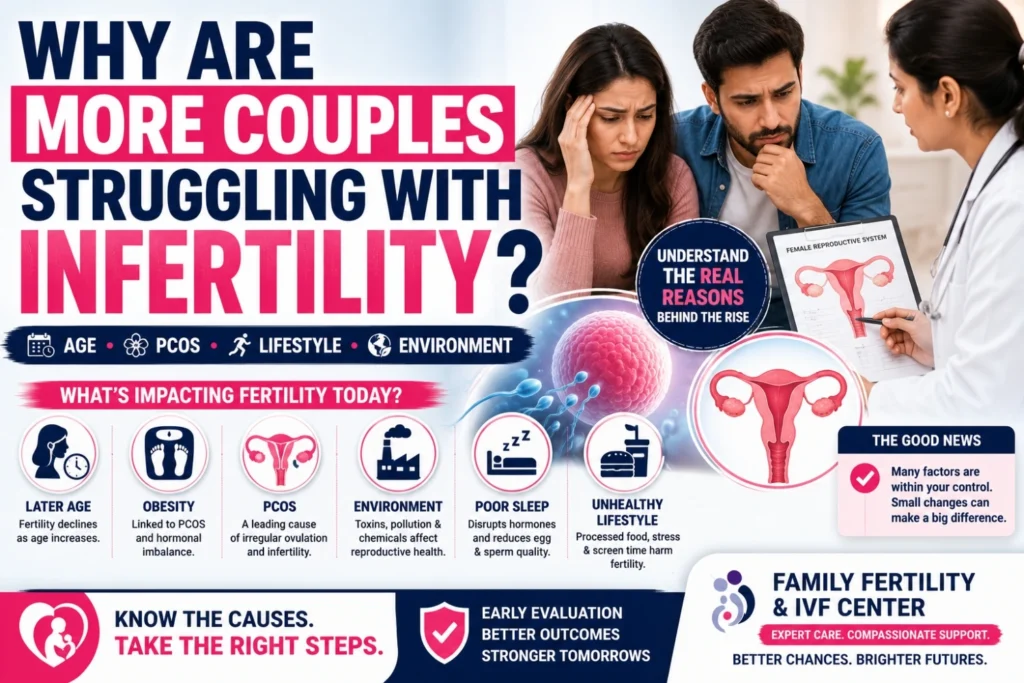
Something has shifted over the last two decades. More couples are struggling to conceive than ever before.
It’s not your imagination. It’s not bad luck either. There are real, identifiable reasons behind this trend.
Marrying and Trying Later
This one’s simple math, but it matters. Women today often marry and start trying for children later than previous generations did.
Where women once had children in their twenties, many now wait until their thirties. And fertility, unfortunately, doesn’t wait with you.
Egg quality and quantity both decline with age. It’s not dramatic overnight, but it adds up over years.
The Weight and PCOS Connection
In South Asia specifically, obesity has become a widespread issue. It rarely travels alone.
Obesity is closely linked to PCOS, or Polycystic Ovary Syndrome. Together, they’re two of the biggest contributors to fertility struggles in the region today.
PCOS disrupts ovulation. Excess weight compounds hormonal imbalance. The combination makes conception significantly harder for a lot of women.
Our Environment Isn’t Helping
This part often surprises people. Fertility isn’t just about age or weight. It’s also about what’s around us daily.
Pesticides in produce. Artificial fertilizers in our food supply. Poor air quality in major cities.
These aren’t abstract concerns. Science has repeatedly linked environmental toxins to reduced fertility in both men and women. It’s a slow, invisible impact, but a real one.
Sleep, Screens, and Junk Food
Modern life runs on late nights and early alarms. Most of us don’t sleep enough, and it shows up in ways we don’t immediately connect to fertility.
Poor sleep disrupts melatonin production. Melatonin isn’t just about rest either. It plays a direct role in maintaining healthy egg and sperm quality.
Add in high consumption of processed foods, and you get a lifestyle that quietly works against reproductive health, day after day.
The Family Planning Timeline Shift
There’s a bigger cultural piece here too, worth acknowledging.
Education and career priorities have shifted for many women. Marriage often happens later than it did for previous generations, and that naturally pushes back when couples start trying to conceive.
None of this is inherently wrong. But it does mean fertility conversations need to happen earlier, ideally in the late twenties or early thirties, rather than waiting until struggles begin.
A simple fertility check-up before you’re actively trying can flag issues early, when they’re often easier to address.
So What Can You Actually Do?
You can’t fix pollution levels or reverse global trends. But you can control quite a bit within your own life.
Start with weight management, through diet and consistent movement, not crash diets. Small, sustainable changes matter more than extreme ones.
Fix your sleep schedule where possible. Going to bed and waking up at consistent times helps your body regulate hormones naturally.
Reduce stress where you realistically can. Chronic stress affects hormone balance more than most people realize.
Be mindful of environmental exposure where it’s within your control. Washing produce thoroughly and improving indoor air quality are small steps, but they add up.
A Quick Look at the Numbers
Some context helps here. Globally, roughly one in six couples experiences some form of infertility during their reproductive years. That number has climbed steadily over the past few decades.
In many South Asian countries, the numbers skew even higher, largely due to the overlapping factors already discussed: rising obesity, later marriages, and environmental exposure.
This isn’t meant to alarm anyone. It’s meant to normalize the conversation. Struggling to conceive isn’t rare or shameful. It’s an increasingly common experience, and one worth addressing openly rather than quietly.
What About Supplements and Quick Fixes?
It’s tempting to search for a shortcut. Supplements marketed for fertility are everywhere, promising quick results.
Some, like folic acid or vitamin D, have solid research behind them for supporting reproductive health. Others make bold claims without much evidence to back them up.
Before spending money on trendy supplements, a simple bloodwork panel can show you what your body is actually deficient in. That’s a far more useful starting point than guessing.
Why This Matters for Couples Trying to Conceive
None of these factors work in isolation. They stack.
A woman in her mid-thirties, carrying extra weight, sleeping five hours a night, and living in a polluted city faces a very different fertility picture than someone without these overlapping factors.
The good news? Many of these are modifiable. Age isn’t reversible, but weight, sleep, and lifestyle habits are.
It’s Rarely Just One Cause
Fertility struggles rarely come down to a single, isolated reason. It’s usually a combination.
Maybe it’s age plus stress. Maybe it’s PCOS plus poor sleep. Maybe it’s environmental exposure layered on top of a busy, high-pressure lifestyle.
Identifying which combination applies to you takes proper evaluation, not guesswork. That’s exactly why a personalized consultation matters more than generic advice found online.
Men Aren’t Exempt From This Trend
Most conversations about infertility focus heavily on women. That’s a mistake.
Sperm counts globally have been declining for decades. Researchers have linked this to several of the same factors already mentioned: environmental toxins, poor sleep, processed diets, and rising obesity rates.
Heat exposure matters too. Frequent hot baths, tight clothing, or laptops resting directly on the lap can all affect sperm quality over time. Small habits, but they add up.
If a couple is struggling to conceive, both partners deserve equal attention during evaluation. Fertility isn’t a one-sided issue, and it never really was.
The Role of Stress in All of This
Stress doesn’t get enough credit as a fertility factor, mostly because it’s hard to measure precisely.
Chronic stress affects cortisol levels, which in turn can disrupt the hormones responsible for ovulation and sperm production.
This creates a frustrating cycle. Trying to conceive causes stress. Stress then makes conceiving harder. Breaking this cycle isn’t easy, but small steps, therapy, support groups, even short daily walks, can genuinely help.
When Lifestyle Changes Aren’t Enough
Sometimes, even with the best lifestyle adjustments, conception doesn’t happen naturally. That’s not a personal failure. It’s simply a sign that medical support is needed alongside lifestyle changes.
This is where a proper fertility evaluation becomes useful, not as a last resort, but as a smart next step once lifestyle factors have been addressed.
Dr. Sophia Umair Bajwa discusses this exact rise in infertility on her YouTube channel, breaking down the science behind each factor in more depth for anyone wanting a closer look.
For couples in Lahore facing these modern fertility challenges, Family Fertility & IVF Center offers a starting point for understanding exactly where things stand and what steps make sense next.
If this topic feels familiar or you’re wondering what your next step should be, share your thoughts in the comments here or on the related video. Let’s discuss it together.