
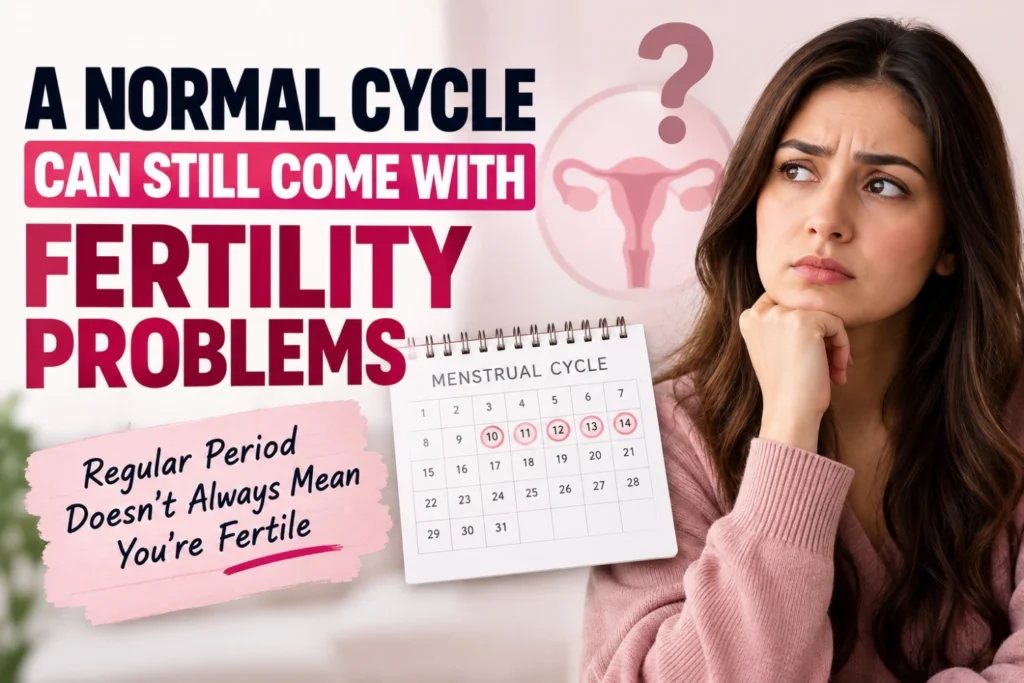
You mark your calendar every month. Same timing. Same flow. Nothing unusual. So when you start trying to conceive, you assume everything inside is working fine too.
Here’s the part most people don’t expect: a regular cycle doesn’t rule out a fertility problem. It just means one part of the system is doing its job. There are still a few others that could be quietly off.
Why “Regular” Doesn’t Mean “Fertile”
Your period shows up because your uterine lining builds and sheds on schedule. That’s it. It doesn’t tell you whether your eggs are healthy. It doesn’t tell you whether your fallopian tubes are open. It doesn’t tell you what’s happening with conditions like PCOS, endometriosis, fibroids, or low ovarian reserve.
Dr. Sophia Umair Bajwa sees this mix-up often in her practice. Women come in confused, sometimes a little defensive, saying their cycle has always been perfect. And she’s not trying to alarm anyone. She’s just pointing out that fertility depends on more moving parts than a monthly date on the calendar.
The Conditions That Hide Behind Normal Cycles
A few culprits show up again and again.
PCOS can exist with fairly regular periods, especially in milder forms. Endometriosis often causes no obvious cycle disruption at all, even while it affects the ovaries or tubes. Fibroids can sit in the uterus for years without changing your bleeding pattern. And low AMH, which reflects your remaining egg supply, has nothing to do with how punctual your period is.
None of these show up on a calendar. They show up on a scan, a blood test, or sometimes only during a procedure.
When Should You See a Fertility Specialist?
There’s a simple rule of thumb here.
If you’re under 35 and you’ve been trying for a year without success, it’s worth getting checked. If you’re 35 or older, that window shrinks to six months.
Waiting longer than that rarely helps. It usually just delays answers you could have gotten sooner.
What Happens During a Fertility Evaluation?
This part surprises people too. Seeing a fertility specialist doesn’t mean you’re being fast-tracked to IVF.
A first visit usually starts with hormone testing and an ultrasound, to get a clear picture of your uterus and ovaries. If something specific needs a closer look, your doctor might recommend further tests, like an X-ray of the tubes or a laparoscopy.
A good specialist works through this step by step. Nothing is assumed in advance. Nothing is oversold.
What You Should Expect From Good Fertility Care
Fertility can leave you with more questions than answers, mostly because so much of it happens invisibly. You can’t see hormone levels. You can’t see tube patency. You can’t see the size of a fibroid from the outside.
That’s exactly why the right kind of guidance matters so much here.
At Family Fertility & IVF Center in Lahore, this is the approach patients get from day one. Careful testing. Honest conversations. No rushing anyone into a treatment plan before the picture is even clear.
Dr. Sophia Umair Bajwa often breaks these topics down on her YouTube channel too, walking through exactly what regular versus irregular cycles can and can’t tell you. If you want to see the reasoning behind all this laid out visually, it’s worth a watch.
Clarity Can Be Reassuring
There’s something calming about understanding your own body a little better. Even if the news isn’t what you hoped for, clarity beats uncertainty.
And if the tests come back clean, that’s reassurance too. You’ll know your next steps are grounded in something real, not fear or assumptions.
If Something Feels Off, It’s Worth Getting Checked
A regular period is a good sign. It’s just not the whole story.
If you’ve been trying to conceive for a while and something still feels off, don’t wait for your cycle to give you a clue it was never designed to give.
Get the testing. Ask the questions. Let a specialist look at the parts you can’t see on your own.
If any of this feels familiar, don’t sit with the confusion alone. The team at Family Fertility & IVF Center in Lahore can walk you through what your specific situation might need.
Got questions of your own after reading this? Leave them in the comments, or under Dr. Sophia Umair Bajwa’s latest video. We read every single one.