
An ultrasound can tell you a lot. But it can’t tell you everything.
Some fertility problems hide in places a scan simply can’t reach clearly. A blocked tube. A stray patch of scar tissue. A small growth tucked inside the uterine cavity.
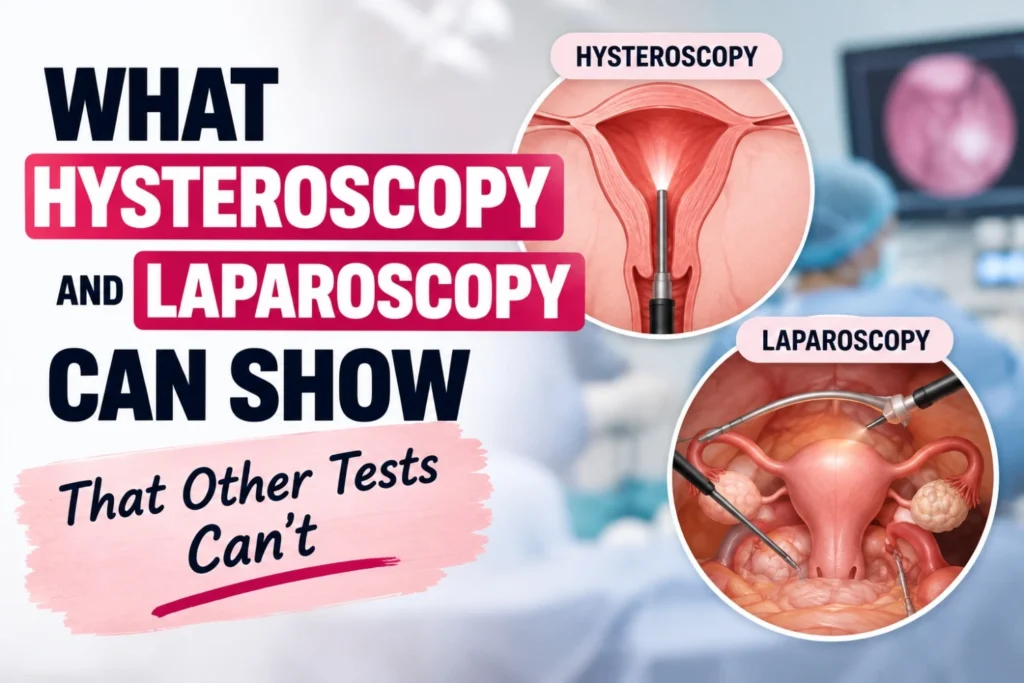
This is where two procedures come in: hysteroscopy and laparoscopy. Different tools. Different views. Together, they answer questions no blood test or scan can fully answer.
Two Procedures, Two Very Different Views
It helps to think of these as two cameras, each looking at a different part of the system.
Hysteroscopy: A Look Inside the Uterus
A hysteroscopy uses a thin, lit scope passed through the cervix into the uterus. No incisions needed.
It lets your doctor see the uterine cavity directly. Polyps, fibroids growing inward, scar tissue, or an unusual shape of the uterus, all of it becomes visible in real time.
Sometimes what’s found can be treated in the same sitting. A small polyp, for instance, can often be removed right then, without a second procedure.
Laparoscopy: A Look at the Outside Structures
A laparoscopy works differently. It’s a minor surgery, done through a few small incisions in the abdomen, using a camera to view the ovaries, fallopian tubes, and the outer surface of the uterus.
This is often how endometriosis gets confirmed. It’s also how doctors check whether the fallopian tubes are actually open.
How Doctors Check If the Tubes Are Open
This next part is one of the more clever pieces of the process.
During a laparoscopy, a colored dye is passed through the uterus and tubes. If the dye flows through and spills out at the end of the tubes, they’re open. If it doesn’t, that’s a sign of a blockage.
Dr. Sophia Umair Bajwa explains this step in detail on her YouTube channel, showing exactly what doctors are watching for in that moment. It’s one of those things that makes far more sense once you actually see it happen, rather than just reading about it.
Why These Tests Matter Even With Normal Reports
Here’s something that trips a lot of people up. You can have a normal ultrasound and normal hormone levels, and still have a problem that only shows up during one of these procedures.
Small fibroids inside the cavity. Mild endometriosis. A partially blocked tube. None of these are guaranteed to show up on a routine scan.
That’s the value of going a layer deeper when the simpler tests haven’t found an answer.
When Doctors Recommend Them
These procedures aren’t the first step for everyone. Usually, they come after basic testing, when something still doesn’t add up, or when a couple has been trying for a while without a clear cause identified.
A thoughtful specialist won’t jump straight here. But when the timing is right, these tests can uncover exactly what months of guessing couldn’t.
Treatment and Diagnosis, Sometimes at Once
One of the more reassuring parts of both procedures is this: diagnosis and treatment can happen together.
Found a polyp during a hysteroscopy? It can often be removed on the spot. Found mild scar tissue during a laparoscopy? In some cases, that can be addressed right there too.
This is part of what makes these procedures feel less like waiting for results and more like actually moving forward.
Where to Go From Here
If you’ve had the basic tests and you’re still without answers, this might be the next honest step.
At Family Fertility & IVF Center in Lahore, both hysteroscopy and laparoscopy are performed with exactly this purpose. Not to add more procedures for the sake of it, but to finally see what’s been missed.
Dr. Sophia Umair Bajwa walks patients through what to expect before recommending either one, so nothing about the process feels sudden or unclear.
A Small Step That Can Answer a Big Question
These procedures can feel intimidating. In practice, they’re usually quick, and the clarity they bring is often worth it.
If months of testing have left you with more questions than answers, this might finally close that gap.
For guidance on whether either procedure fits your situation, the team at Family Fertility & IVF Center in Lahore is a solid place to start that conversation.
Curious about anything else in this process? Drop it in the comments below, or under Dr. Sophia Umair Bajwa’s video on the topic. We’re always glad to dig into it further.