
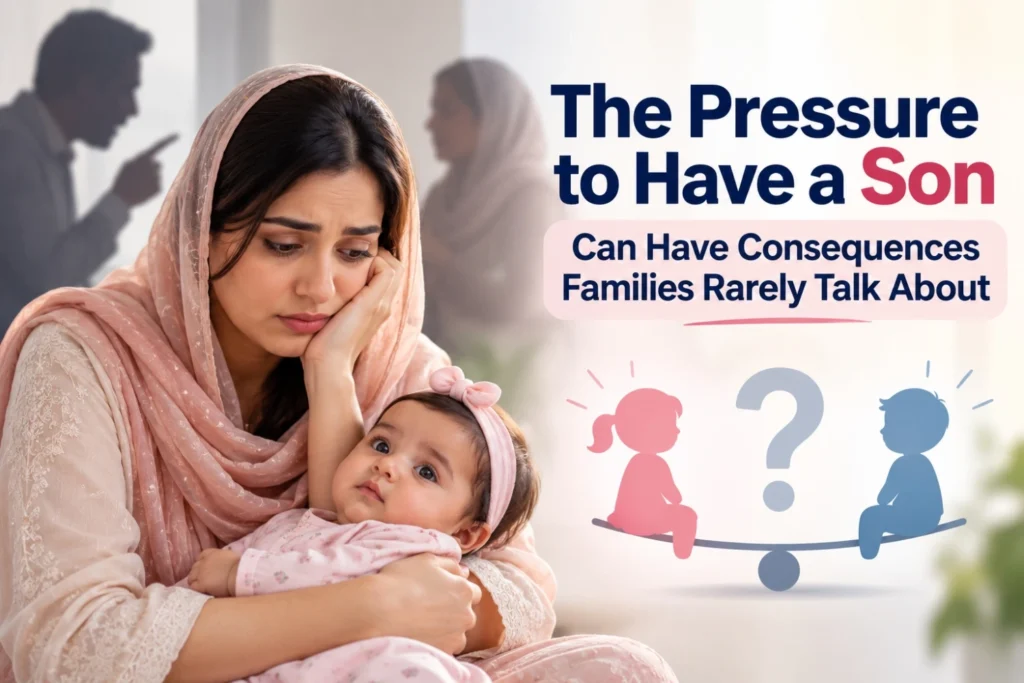
A baby’s gender is decided by the father’s sperm. Yet in many homes, the mother carries all the blame when a daughter is born. The result can be repeated pregnancies, lasting health damage and, in the worst cases, violence or abandonment. These consequences are real, and they are rarely discussed in public.
Dr. Sophia Umair Bajwa is a fertility specialist at Family Fertility & IVF Center in Lahore. She spoke about this issue with host Falak Chauhan. Their conversation covered the science of gender, the pressure placed on women, medical ethics and the legal position in Pakistan. This blog sets out the main points in plain terms.
The Science of Baby Gender
Gender is determined by the father
Every egg carries an X chromosome. A sperm carries either an X or a Y. If an X sperm fertilizes the egg, the baby is a girl. If a Y sperm does, the baby is a boy. Dr. Bajwa makes this point clearly: the father’s sperm decides, and the mother’s eggs do not.
This is basic biology, yet it is still widely misunderstood. Many families treat the birth of a daughter as the mother’s failure. Medical science does not support that view. A woman has no control over this outcome. Neither a ritual nor a home remedy changes it.
Superstitions have no scientific basis
Some people still speak of “the disease of having girls.” Dr. Bajwa dismissed this idea as scientifically baseless. There is no medical condition that makes a woman give birth only to daughters. Beliefs like this persist because they have been repeated for generations, not because evidence supports them.
How Social Pressure Affects Women
Repeated pregnancies
In some households, a woman is expected to keep trying until she has a son. Each pregnancy places heavy demands on the body. Iron levels drop, energy is depleted and delivery carries its own risks. When pregnancies follow each other closely, the body has little time to recover.
Dr. Bajwa notes that this pattern severely affects both physical and mental health. A woman may face complications that could have been avoided with proper spacing and rest. The pressure to conceive again can override medical advice.
The mental health burden
The psychological cost is just as serious. Women under this pressure often live with constant anxiety. They feel guilt for something they did not cause. They may also feel isolated, because the topic is rarely spoken about openly.
Over time, this stress can lead to depression and loss of self-worth. It also affects how a woman bonds with her children. Every child, regardless of gender, benefits when the mother is supported rather than blamed.
Abuse and abandonment
The discussion also addressed violence. Some women face abuse after giving birth to daughters. Others are abandoned by their husbands or in-laws. These are among the most serious outcomes of son preference.
Such cases often stay hidden. Women may fear speaking up because they depend on the family for housing and support. Raising awareness is one step toward making help easier to reach. Community leaders, doctors and relatives can all play a part by speaking up when they notice warning signs.
Medical Ethics and the Law
Revealing the baby’s sex
In Pakistan, it is not illegal for a doctor to tell parents the sex of their baby. Even so, many doctors hesitate. If a doctor senses that the patient is under pressure at home, silence may be the safer choice. The aim is to protect the mother from potential harm.
This is an ethical judgment, not a legal rule. It shows how closely doctors watch the home situation of their patients. A single sentence in a clinic can change what happens in a household later that day.
The legal position on abortion
Abortion is not legal in Pakistan, except in specific cases. These are when the mother’s life is at risk or when the fetus has severe physical defects. The sex of the baby is not a lawful reason to end a pregnancy.
This is important for families to understand. Pressure to terminate a pregnancy because of gender has no legal or medical justification. It can also put the woman’s life at risk.
Patient confidentiality
Dr. Bajwa also stressed that a doctor’s duty is to the patient. Sharing private health information on social media is a serious ethical breach. It violates the doctor-patient relationship and can expose patients to real harm. Doctors who respect this duty help women feel safe enough to ask honest questions.
Patients should be able to trust that what they share stays private. This matters most for women who are already under pressure and need a safe place to talk. For patients in Lahore, Family Fertility & IVF Center treats confidentiality as a basic standard in every consultation.
What Women Should Know
Your baby’s gender is not your doing
The first point is the simplest. A woman does not decide the gender of her baby. Knowing this can lessen guilt and help her respond to unfair blame with confidence. Science is on her side.
Protect your health between pregnancies
Rest, nutrition and regular checkups all matter. Doctors often advise leaving enough time between pregnancies so that the body can recover. If you feel pushed into another pregnancy before you are ready, speak with a doctor. Medical advice should guide these decisions, not family pressure.
Reach out for support
A trusted doctor, relative or friend can offer practical and emotional help. Talking early can stop a difficult situation from getting worse. If you are in danger at home, contact local support services without delay. No woman should face this alone. Writing down your concerns before an appointment can make the conversation easier.
What Families Should Know
Attitudes affect a mother’s well-being
Husbands and in-laws have a major influence on a woman’s experience of pregnancy. Support and respect improve her physical and mental health. Blame and pressure do the opposite. Families have a direct role in creating a safe environment.
Every child has equal value
Girls and boys both need care, education and love. When families value them equally, the pressure on the mother eases. This also builds healthier homes for the next generation. Change at the family level can spread much further than most people expect.
Conclusion
Son preference is often treated as a private family matter. In reality, it is also a public health issue. It affects pregnancies, mental health and personal safety, and it rests on a misunderstanding of basic biology.
Women who want accurate information and respectful care can book a consultation at Family Fertility & IVF Center in Lahore. A private conversation with a specialist can clarify medical facts, address fears and help plan a healthy pregnancy at the right pace.
Join the Conversation
The full discussion between Dr. Sophia Umair Bajwa and Falak Chauhan are available on the Youtube channel. If this topic matters to you, share your thoughts in the comments here or on the video. We read every question and will cover the common ones in a future post.