
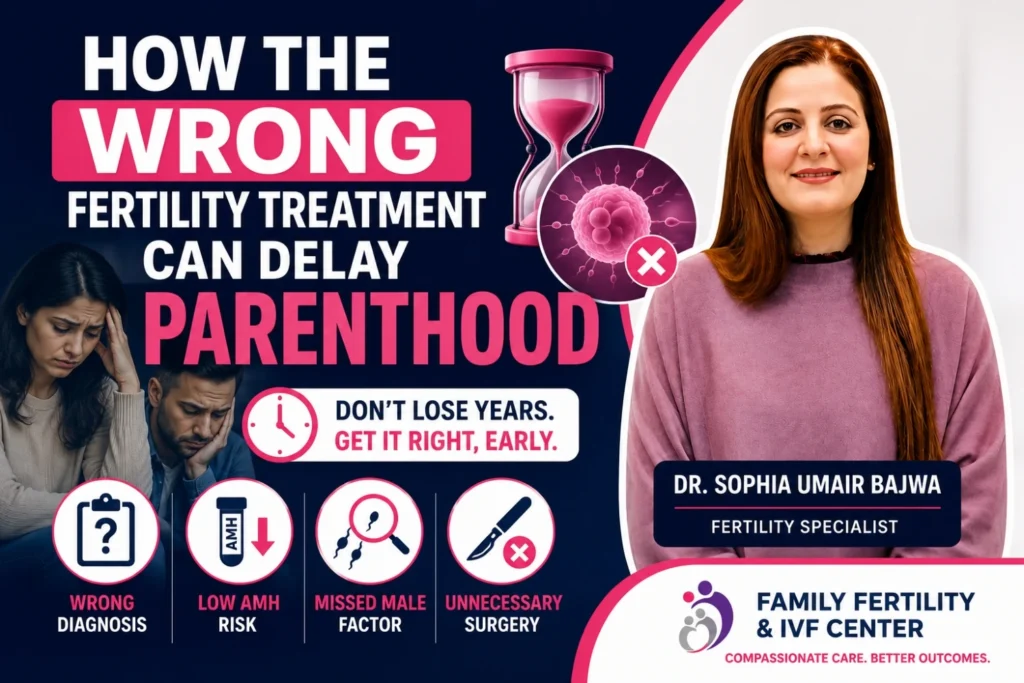
Nobody starts fertility treatment expecting it to take years longer than it should. But for a lot of couples, especially outside major cities, that’s exactly what happens.
Dr. Sophia Umair Bajwa has seen this pattern repeat itself often enough that she decided to talk about it directly. Alongside her marketing manager, Mr. Rabail Baig, she broke down exactly where things tend to go wrong.
And honestly, it’s worth understanding, even if you’re not currently struggling with fertility.
The Delay That Starts With the Wrong Diagnosis
Here’s a pattern that shows up again and again.
A couple in a smaller city starts trying to conceive. Months pass. Nothing happens. They see a local doctor.
Instead of running a full set of investigations, they’re handed basic ovulation-inducing medication. Try this. Come back in a month.
A month turns into six. Six turns into two years.
The problem isn’t that the medication is wrong in every case. The problem is using it as a blanket solution, without first understanding what’s actually causing the delay.
That’s time nobody gets back.
The Earlier You Know Your AMH, the Better
This is where things get more concerning.
Dr. Bajwa points out something critical. Repeated, unsupervised use of ovulation-inducing drugs can actually deplete a woman’s egg reserve over time.
That drop shows up in AMH levels. Anti-Müllerian Hormone. It’s essentially a marker of how many eggs a woman has left.
Lower AMH means fewer options. Fewer options mean harder decisions, later.
This is exactly why proper testing needs to happen early. Not after years of trial and error.
The Male Factor That Often Gets Overlooked
Fertility struggles aren’t only about the woman. That bears repeating, because the burden often falls entirely on her, even when the cause lies elsewhere.
Rabail brought up something important here. In smaller cities, basic semen analysis is frequently done incorrectly.
Not because labs are careless. But because the testing standards aren’t always consistent outside specialized fertility centers.
The result? Male infertility issues go undetected. Sometimes for years. While the woman continues undergoing tests, treatments, and procedures that were never going to solve the actual problem.
Surgery Is Not Always the Answer
This next part is one that deserves real attention.
There’s a common trend, particularly in Pakistan, of choosing general surgeons over fertility specialists for gynecological surgeries. Ovarian cysts, for example.
It might seem like a small decision. A surgeon is a surgeon, right?
Not quite.
Unnecessary or poorly performed surgery can cause irreversible damage. Damage that drastically lowers the chances of a future pregnancy.
Once that kind of harm is done, there’s often no undoing it.
This is why the choice of surgeon matters just as much as the choice of treatment.
What Quality Fertility Care Looks Like
It starts with a full, proper diagnosis. Not assumptions. Not shortcuts.
It means AMH testing done early enough to still matter. Semen analysis done correctly, the first time. And any surgical decisions made by someone who understands exactly how reproductive anatomy works.
This is the kind of thorough approach patients can expect at Family Fertility & IVF Center in Lahore, where every case starts with proper investigation, not guesswork disguised as treatment.
Never Be Afraid to Ask Another Fertility Specialist
If there’s one thing worth taking away from all this, it’s this. Seeking a second opinion is not disloyal to your first doctor.
Dr. Bajwa and Rabail both emphasized this strongly. If something about your treatment plan doesn’t sit right, or progress has stalled without explanation, get another set of eyes on your case.
Ideally, from a qualified fertility specialist. Not just any surgeon or general practitioner.
Time Is Too Valuable for Trial and Error
Fertility treatment already comes with enough emotional weight. The waiting. The disappointment. The hope that rises and falls with every cycle.
The last thing anyone needs is additional years lost to the wrong treatment path.
That’s why this conversation matters so much. Not to scare anyone. But to make sure people know what questions to ask, and what red flags to watch for, before years slip by.
If this resonates with your own experience, or you have questions about diagnosis, testing, or treatment options, drop a comment on this post or under the video itself.
We’ll dive into it, one question at a time.
Because parenthood delayed by the wrong treatment is a story that happens far too often. And it’s one that, with the right information, doesn’t have to happen at all.