
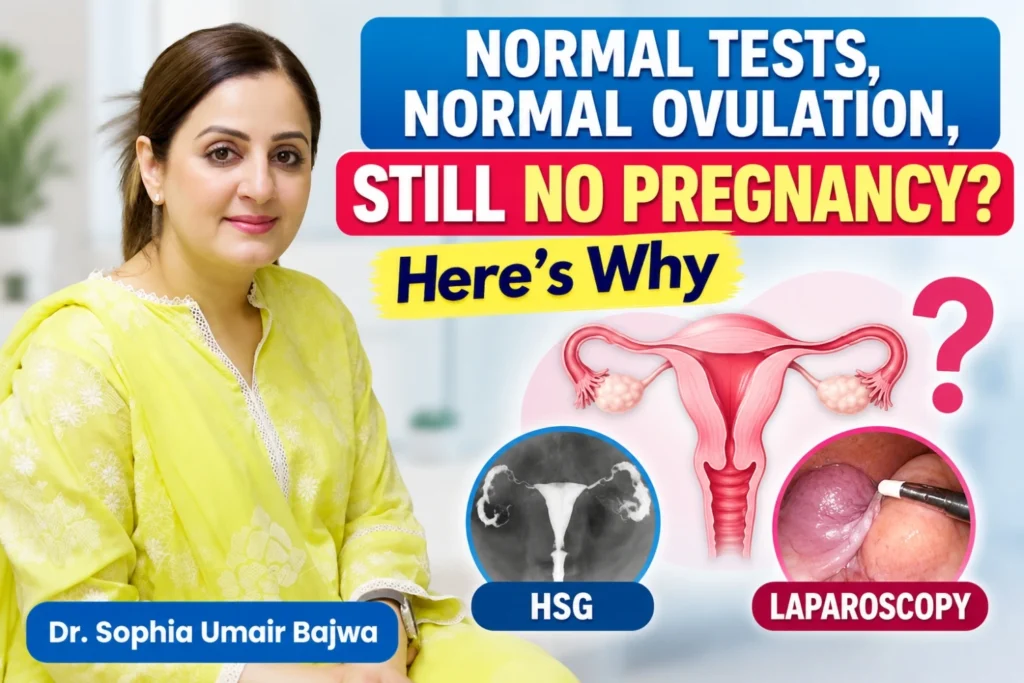
Every test came back normal. Your ovulation is right on schedule. Your partner’s semen analysis is completely fine.
On paper, there seems to be no reason you shouldn’t be pregnant by now. Yet here you are. Another negative test. Another round of questions about what the reports aren’t showing.
If this frustration feels familiar, there may be a missing piece. It may simply be something that hasn’t been checked yet.
What Normal Results Don’t Reveal
This can be one of the most frustrating situations in fertility care. Everything looks fine. It’s easy to assume pregnancy will happen with more time.
But normal ovulation and a normal semen analysis only cover two parts of the fertility picture.
The fallopian tubes are another important part. They play a key role in conception. If they are blocked or damaged, pregnancy may not happen.
This can go unnoticed if the tubes haven’t been properly evaluated. Fertility medications won’t fix a blocked tube.
When the Problem Isn’t Ovulation
Many couples go through several cycles of ovulation induction or timed intercourse. Their tubes may not be checked during this time.
This doesn’t mean doctors are being careless. Tube testing is often not the first test ordered. By the time it is considered, months or even years may have passed.
That is why knowing how your tubes can be checked matters.
HSG vs Laparoscopy
There are two main ways to evaluate the fallopian tubes. They work in very different ways.
HSG: The Faster, More Affordable Option
HSG stands for hysterosalpingography. It is an X-ray test. A dye is passed through the cervix. The doctor then checks how the dye moves through the tubes.
The procedure is usually quick. It also costs less than surgical testing in many settings. This makes HSG a common first step.
HSG has some limitations, though. It does not directly look inside the tubes. In some cases, it may suggest a blockage when the tube is actually open.
This can cause unnecessary worry. It may also lead to further testing.
Some women also find HSG uncomfortable or painful. Knowing this beforehand can help you prepare.
Laparoscopy: Benefits and Limits
Laparoscopy gives the doctor a direct view of the reproductive organs. A small camera is used during the procedure.
The doctor can examine the uterus, ovaries, and fallopian tubes. This can provide more detailed information than an X-ray.
Hysteroscopy may also be performed when needed. It allows the doctor to examine the inside of the uterus.
Laparoscopy does require surgery and anesthesia. It also involves recovery time.
In some cases, the doctor can treat certain problems during the same procedure. This can make laparoscopy both diagnostic and therapeutic.
When More Testing Is Needed
Time matters in fertility care. A woman’s reproductive window is limited.
Repeated fertility medication cycles may not help if an underlying problem has not been identified. They can also delay the right diagnosis.
This is why your treatment plan may need to change when pregnancy doesn’t happen as expected.
Finding the Missing Answer
Wanting to avoid surgery is completely understandable. Many patients feel the same way.
But repeated negative results may call for a deeper evaluation. This can help identify problems that routine testing has missed.
The goal is to understand the cause before continuing with the same approach.
Book Your Fertility Consultation With Us
If your tests look normal but pregnancy still isn’t happening, look beyond the standard checklist.
Ask what has been evaluated. Ask what may still be missing.
Dr. Sophia Umair Bajwa discusses this situation in detail. She explains why fallopian tube evaluation can matter during a fertility workup.
Sometimes, the next step is simply finding the right test. Getting that answer can help shape a more informed treatment plan.
Family Fertility & IVF Center in Lahore provides fertility evaluations for couples looking for clearer answers.
Unexplained infertility may have an explanation. It may simply require a more thorough evaluation.
Watch Dr. Sophia Umair Bajwa‘s video to learn more about HSG and laparoscopy. You can also share your questions or experience in the comments below the video.