
Many couples spend months trying to conceive without success, not because anything is medically wrong, but simply because the timing isn’t right.
The truth is, pregnancy is only possible during a few specific days each menstrual cycle. Miss this narrow window, and the chances drop to nearly zero, no matter how frequently you try.
This is exactly why timing comes up in almost every consultation at Family Fertility & IVF Center in Lahore. In this blog, we’ve explained everything simply and clearly. One read, and you’ll never have to guess again.
How Important Is Timing in This Situation?
Research shows that on the most fertile day of a cycle, the chance of conception from a single attempt is around 25 to 30 percent for a healthy couple.
Outside the fertile window, that number drops to zero.
Trying at the right time does not guarantee pregnancy. But trying at the wrong time almost guarantees it will not happen that cycle.
What Is the Fertile Window?
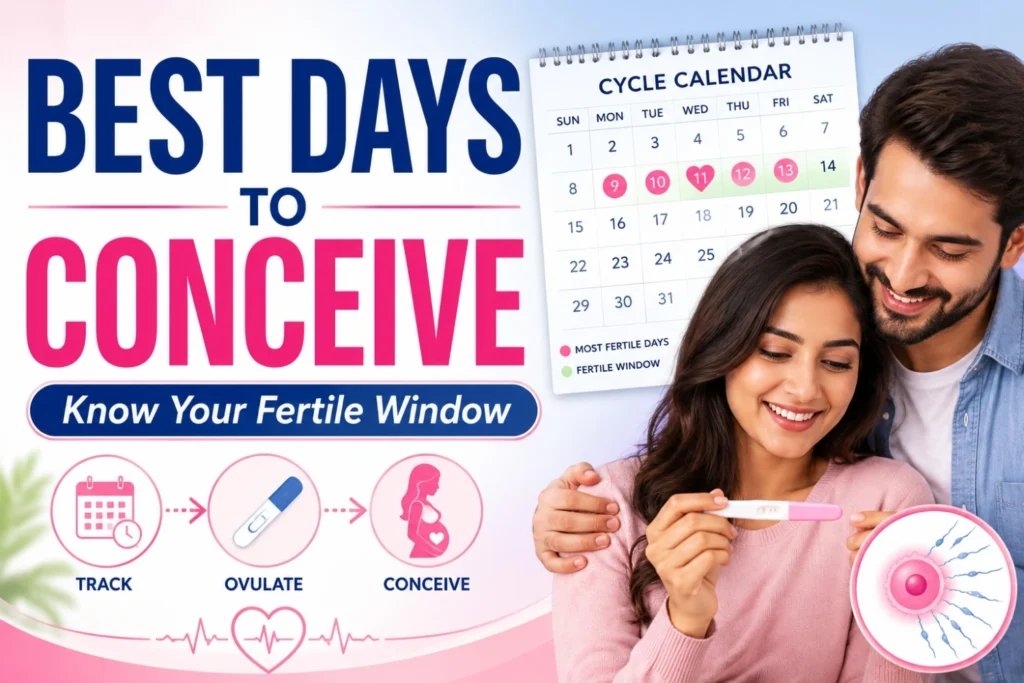
The fertile window is the set of days in a cycle when pregnancy is actually possible.
It lasts about 5 to 6 days per cycle. Here is why:
- An egg is released during ovulation and survives for only 12 to 24 hours
- Sperm can survive inside the body for up to 5 days
- Together, this creates a window of roughly 5 to 6 days
The most productive days are the two to three days leading up to ovulation and ovulation day itself.
After ovulation passes, the window closes until the next cycle.
How Do You Calculate Your Ovulation Day?
Ovulation happens 14 days before the next expected period, regardless of how long the cycle is.
So the formula is simple: subtract 14 from your cycle length.
21-day cycle: Ovulation around Day 7. Fertile window: Days 2 to 7.
28-day cycle: Ovulation around Day 14. Fertile window: Days 9 to 14.
35-day cycle: Ovulation around Day 21. Fertile window: Days 16 to 21.
The cycle length changes when ovulation happens. The 14-day gap before the period stays the same.
Why Does Cycle Length Change the Fertile Window?
Every cycle has two phases.
The first phase runs from Day 1 of the period to ovulation. This phase varies in length from woman to woman and even cycle to cycle.
The second phase runs from ovulation to the next period. This is almost always 14 days.
So a shorter cycle means ovulation comes earlier. A longer cycle means it comes later.
Applying a fixed “Day 14” rule to every woman is where a lot of couples go wrong. It only fits a 28-day cycle.
How Long Do Eggs and Sperm Survive?
Egg:
- Released at ovulation
- Survives for 12 to 24 hours only
- If not fertilised in that window, it breaks down
Sperm:
- Can survive 3 to 5 days inside the reproductive tract
- Quality and motility decrease over time
- Survives longest in fertile cervical mucus
This is why starting a few days before ovulation works better than waiting for ovulation day itself. Sperm can be present and ready when the egg arrives.
What Are the Best Days to Try?
Studies published in the New England Journal of Medicine confirm that the two days just before ovulation give the highest chance of conception.
Ovulation day itself is also highly effective. The day after ovulation, probability drops sharply.
Practical approach:
- Find your estimated ovulation day using the formula above
- Start trying from 3 to 4 days before that date
- Continue through ovulation day
- Try every other day, not every single day
Trying every day does not improve the odds. It can actually lower sperm count without adding any benefit. Every other day within the fertile window is the evidence-backed recommendation.
How Do You Know When You Are Ovulating?
The body gives clear signals. Most women just were not taught to notice them.
Signs to look for:
- Cervical mucus becomes clear, stretchy, and slippery, similar to raw egg white
- Mild one-sided pelvic ache around ovulation day
- Slight rise in basal body temperature after ovulation
- Increased energy or sex drive around mid-cycle
- Occasional light spotting
Tools that help:
- Ovulation predictor kits (OPKs) detect the LH hormone surge that happens 24 to 36 hours before ovulation. Simple to use and widely available.
- Basal body temperature tracking shows a pattern over time. Temperature rises slightly after ovulation occurs.
- Cycle tracking apps help identify patterns when used consistently over several months.
OPKs combined with cervical mucus observation give the clearest real-time picture of the fertile window.
A Simple Rule to Follow Every Cycle
- Track your cycle for two to three months
- Count from the first day of one period to the first day of the next
- Subtract 14 from that number to find your estimated ovulation day
- Start trying three days before that date
- Continue every other day through ovulation day
- Watch for cervical mucus changes as a natural confirmation
- Use an OPK if you want more certainty
That is the complete system. No complicated charts needed.
When Should You See a Specialist?
For women under 35, the recommendation is to seek evaluation after 12 months of well-timed trying without success.
For women over 35, that timeframe shortens to 6 months.
If cycles are very irregular, ovulation may not be happening consistently. Conditions like PMOS, thyroid issues, or hormonal imbalances can interfere with ovulation entirely and need proper assessment.
Dr. Sophia Umair Bajwa covers cycle tracking, ovulation signs, and hormonal health in detail on her YouTube channel. Her videos are practical, clearly explained, and genuinely useful for anyone actively trying to conceive.
If something feels off or the timing has been right but pregnancy has not happened, a proper fertility evaluation is the right next step.
Family Fertility & IVF Center in Lahore provides complete assessments for both partners. Hormonal panels, ultrasound monitoring, semen analysis. The full picture before any treatment is recommended.
Quick Summary
- Fertile window lasts 5 to 6 days per cycle
- Eggs survive 12 to 24 hours. Sperms survive up to 5 days.
- Ovulation happens 14 days before the next period
- Cycle length shifts the ovulation date, the 14-day gap stays fixed
- The two days before ovulation give the highest conception probability
- Try every other day within the fertile window
- OPKs and cervical mucus tracking are the most reliable tools
Frequently Asked Questions
Can you get pregnant outside the fertile window? Extremely unlikely. Pregnancy requires a living egg, which only survives 12 to 24 hours after ovulation. Outside that window, conception is biologically not possible.
What if my cycles are irregular? Irregular cycles make prediction harder. OPKs become more useful since they detect the actual LH surge rather than relying on a calculated date. A specialist can also check if irregular cycles point to an underlying issue.
Does stress affect ovulation timing? Yes. Significant stress can delay or disrupt ovulation by affecting hormonal signals in the brain. This is one reason cycles sometimes shift during stressful periods.
Can you ovulate more than once in a cycle? Two eggs can release within the same 24-hour window, which is how fraternal twins happen. A second separate ovulation later in the same cycle does not occur.
Does age affect the fertile window? Age affects egg quality and the probability of conception per cycle. The fertile window follows the same biological rules, but chances within it decrease as egg quality declines with age.
Is it possible to ovulate right after a period? In shorter cycles, yes. A woman with a 21-day cycle can ovulate as early as Day 7, which may overlap with the tail end of her period.
How many cycles should we try before seeking help? Under 35: try for 12 months with correct timing before seeking evaluation. Over 35: 6 months. If cycles are very irregular, do not wait. See a specialist sooner.
The team at Family Fertility & IVF Center offers expert guidance and full fertility evaluations. Contact us to gain a clear picture of where things stand.