
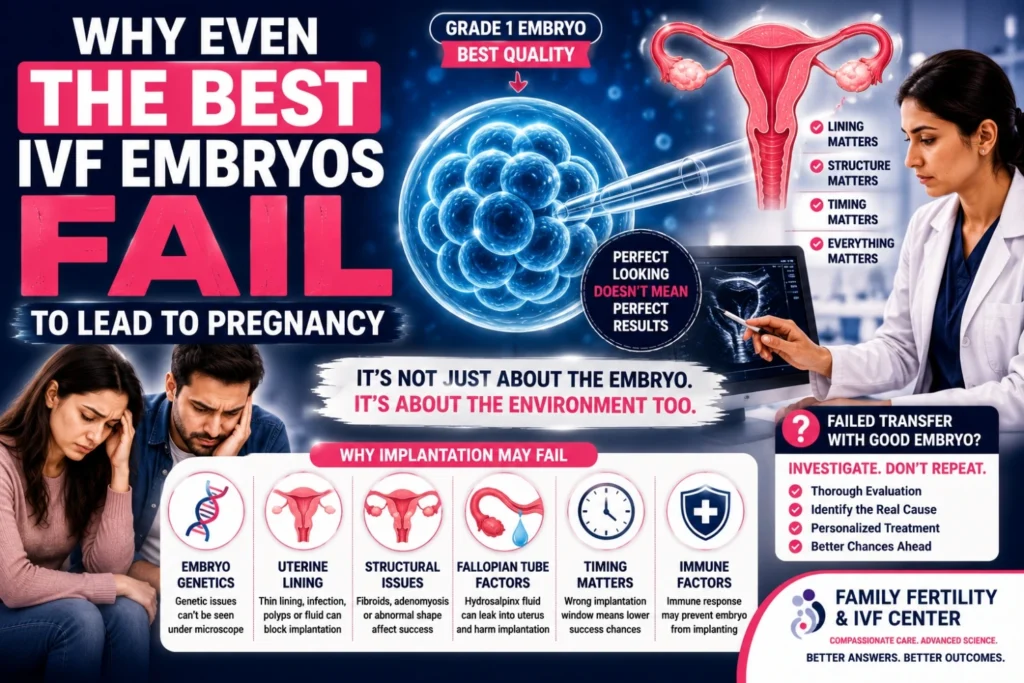
You did the retrieval. You got a Grade 1 embryo, the best possible quality. Everyone told you this was a great sign.
Then the transfer didn’t work.
It’s confusing. It feels unfair. And honestly, it happens more often than most people realize.
Why “Perfect Looking” Doesn’t Mean “Perfect”
Embryo grading is based mostly on appearance under a microscope. Cell number, symmetry, fragmentation, these are what determine the grade.
But appearance doesn’t tell the whole story. Even a Grade 1 embryo can carry genetic abnormalities invisible to the naked eye.
This is one reason genetic testing matters so much, even when an embryo looks flawless. In Pakistan, Dr. Sophia Umair Bajwa notes that roughly 90 percent of patients still skip this testing, often due to cost or lack of awareness.
It’s Not Just About the Embryo
Here’s the part that surprises a lot of patients. A great embryo still needs the right environment to succeed.
Think of the uterus as soil, and the embryo as a seed. Even the healthiest seed won’t grow in poor soil.
The Uterine Lining Matters More Than You Think
The endometrium, or uterine lining, needs to be healthy for implantation to happen.
Infections, polyps, or fluid buildup within the uterus can all interfere with implantation, even when everything else looks perfect.
A thorough evaluation of the lining before transfer can catch these issues early, often before they cause a failed cycle.
Structural Issues in the Uterus
Sometimes the problem isn’t the lining itself, but the structure surrounding it.
Fibroids can distort the uterine cavity. Adenomyosis, which enlarges the uterus, can also interfere with implantation.
Both conditions are treatable in many cases, but they need to be identified first. This is why a detailed scan before transfer matters so much.
Fallopian Tube Complications
Even though embryos are placed directly into the uterus during IVF, fallopian tube issues can still affect outcomes.
Hydrosalpinx, a condition where fluid builds up in the tubes, can create a toxic environment that leaks into the uterus. This can prevent successful implantation, even with a perfect embryo.
Addressing hydrosalpinx before a transfer, sometimes through surgical intervention, can significantly improve the odds of success.
What Should You Do After a Failed Transfer With a Good Embryo?
First, don’t assume it was simply bad luck and try again without investigation. That approach wastes both time and emotional energy.
Ask your doctor to evaluate your uterine lining thoroughly. Request imaging that checks for fibroids, polyps, or adenomyosis. Ask specifically about your fallopian tubes, especially if you’ve had any pelvic infections in the past.
And if genetic testing wasn’t done on your embryo, ask whether it makes sense for your next cycle.
The Role of Immune Factors
This part gets overlooked constantly, even by patients who’ve done extensive research.
Some women have immune responses that treat an embryo as a foreign body rather than allowing implantation. This isn’t common, but it does happen.
Testing for these immune factors isn’t standard everywhere, which means it often only gets considered after multiple unexplained failures with good-quality embryos.
If you’ve had more than one failed transfer with strong embryos and no other explanation found, it’s worth specifically asking your doctor about this possibility.
Timing of the Transfer Itself
Even the day of transfer matters more than people assume.
The uterine lining has a narrow window during which it’s most receptive to an embryo. Miss that window, even by a day or two, and implantation odds drop significantly.
Some clinics now use specialized testing to identify this exact window for each individual patient, rather than relying on a standard calendar-based approach. For patients with previous unexplained failures, this personalized timing can make a real difference.
When to Seek a Second Opinion
If you’ve had one failed transfer with a top-quality embryo, it might just be bad luck. Statistically, that happens.
But if you’ve had two or more failures with good-quality embryos and no clear explanation offered, a second opinion is worth pursuing.
A fresh set of eyes on your case, especially from a specialist who focuses on repeated implantation failure specifically, can sometimes catch something the first evaluation missed.
Do Lifestyle Factors Play Any Role Here?
They can, though usually as a smaller piece of the bigger puzzle.
Chronic inflammation, whether from diet, stress, or underlying health conditions, can affect how receptive the uterine lining is during the implantation window.
Smoking and excessive alcohol intake are also linked to lower implantation rates, even with high-quality embryos. If either applies to you, addressing it before your next transfer is a reasonable, controllable step.
None of these factors alone typically explain a failed transfer. But alongside a proper medical evaluation, addressing them gives your body the best possible conditions going forward.
Rebuilding Confidence After a Failed Transfer
Emotionally, this specific kind of failure hits differently. A poor-quality embryo failing feels expected. A perfect one failing feels almost cruel.
Give yourself space to process that disappointment. It’s a legitimate loss, even without a positive test ever showing up.
Once you’re ready, approach the next round differently. Insist on the deeper investigation outlined above, rather than simply repeating the same steps and hoping for a different result.
Reframing What “Best Quality” Really Means
Grading systems describe what an embryo looks like on day five. They don’t describe everything that determines whether a pregnancy succeeds.
A Grade 1 embryo is a strong starting point, not a guarantee. Understanding this distinction early can save you from unnecessary self-blame if a transfer doesn’t work despite a great-looking embryo.
Success in IVF depends on the embryo, the uterus, and the timing all lining up together. When one piece is off, even briefly, the outcome can change.
Choosing the Right Fertility Center Matters Here
This entire situation highlights something important. Embryo quality alone doesn’t guarantee pregnancy. The full picture matters just as much.
A center that investigates thoroughly after a failed transfer, rather than simply recommending another attempt with fingers crossed, gives you a real chance at understanding what actually happened.
Dr. Sophia Umair Bajwa covers each of these factors in more depth on her YouTube channel, breaking down why a perfect-looking embryo doesn’t always guarantee a perfect outcome.
If you’re in Lahore and dealing with this exact frustration, it’s worth visiting Family Fertility & IVF Center, where this kind of detailed post-transfer investigation happens before any next steps get recommended.