
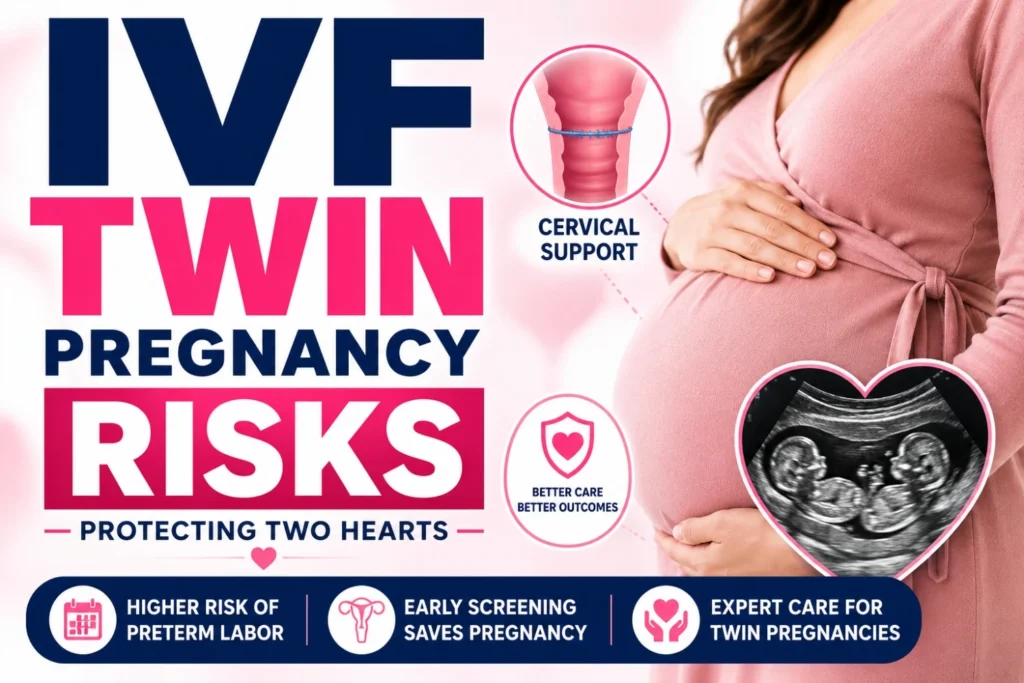
Twin pregnancies carry a much higher risk of preterm labor because the cervix carries far more weight and pressure, much earlier than it would with one baby. In many cases, the loss has little to do with IVF itself. It comes down to a cervix that opens before the babies are ready to arrive.
This is one of the most overlooked parts of twin pregnancy care. Couples go through months of fertility treatment, finally see two heartbeats on the screen, then get blindsided by a complication nobody warned them about. Read on to understand the full picture. We’ll explore why this happens, what the research says, and how doctors work to reduce the risk.
1. Why Carrying Twins After IVF Comes With Higher Risks
1.1 The Extra Pressure on the Cervix
Carrying two babies means double the fluid and double the weight pressing down on the uterus much sooner than a single pregnancy would. The cervix holds all of that pressure closed. Once it can no longer hold the line, labor starts on its own schedule, not the one anyone planned for.
1.2 Why IVF Twins Face Added Risk
IVF pregnancies that result in twins often come from transferring more than one embryo. That group also tends to include women who conceived later in their reproductive years or after a long fertility journey. Add a cervix that is already short or weakened, and the odds of early labor climb quickly.
2. What Is Cervical Insufficiency, and Why Does It Matter?
Cervical insufficiency means the cervix softens and opens too early, often with no pain involved. It matters because symptoms tend to show up late. By the time contractions or bleeding start, the window to act has often already closed.
2.1 Signs That Are Easy to Miss
- A feeling of pelvic pressure that comes and goes
- Mild back pain mistaken for normal pregnancy discomfort
- Spotting with no clear cause
- A sensation of heaviness low in the pelvis
None of these scream emergency on their own. That is exactly the problem.
2.2 What a Short Cervix Means During a Twin Pregnancy
Doctors measure cervical length through a transvaginal ultrasound, usually somewhere between 16 and 24 weeks. A short cervix on that scan is one of the strongest predictors of early labor in twin pregnancies. It outperforms age, weight, and even how the pregnancy was conceived.
3. The Numbers Behind Twin Pregnancy Loss
3.1 Preterm Birth Statistics in Twins
The gap between singleton and twin pregnancy outcomes is significant.
| Outcome | Singleton Pregnancy | Twin Pregnancy |
| Birth before 37 weeks | About 9% | About 60% |
| Birth before 32 weeks | About 2% | Nearly 11% |
| Risk of early neonatal death | Baseline | 5 times higher |
| Share of all preterm deliveries | Not applicable | About 20%, despite twins being roughly 3% of all births |
Twins make up only about 3% of live births. They still account for roughly one in five preterm deliveries overall. That single fact explains why twin pregnancy care leans so heavily on early cervical screening.
3.2 Why the Second Twin Faces Higher Risk
The first twin clears the birth canal first. The second twin often deals with more strain afterward, a higher chance of malposition, and slightly lower Apgar scores compared with the first twin born. This gap is one reason delivery planning for twins gets more detailed as the due date nears.
4. Cervical Cerclage: What It Is and When It Helps
Cervical cerclage is a stitch placed around the cervix to hold it closed mechanically. The concept sounds simple. The outcome depends heavily on timing, technique, and choosing the right patient for it.
4.1 Transvaginal Cerclage
This is the standard approach. The stitch goes in through the vagina, typically between 12 and 24 weeks. It gets used either as a planned step for women with a known history of cervical insufficiency or as a response to a shortening cervix spotted on ultrasound.
4.2 Laparoscopic Cerclage
Laparoscopic cerclage sits higher on the cervix and goes in through small abdominal incisions. This route tends to come up for women who already lost a pregnancy to cervical insufficiency or whose anatomy makes a transvaginal stitch difficult to place.
4.3 What the Research Shows
One study comparing twin pregnancies managed with cerclage against those managed without it found some meaningful gaps.
| Measure | With Cerclage vs Without |
| Pregnancy latency | 12.5 weeks vs 7.7 weeks |
| Average gestational age at birth | 34.1 weeks vs 31.8 weeks |
| Spontaneous birth before 28 weeks | 11.6% vs 37.8% |
| Average birth weight | 2,145g vs 1,733g |
| NICU admission rate | 24.1% vs 43.3% |
These numbers come mostly from observational studies rather than large randomized trials. That limits how confidently doctors can apply cerclage across every twin pregnancy. It still explains why cerclage gets a serious look in cases involving a genuinely short cervix.
5. Who Should Consider Cerclage?
Cerclage is not automatic for every twin pregnancy. Doctors typically weigh it for:
- A cervix measuring 25mm or less on ultrasound before 24 weeks
- A history of prior pregnancy loss linked to cervical insufficiency
- Visible cervical dilation found during a routine exam
- A prior cerclage that worked well in an earlier pregnancy
Cervical length, prior history, and overall risk all factor into the decision. None of these get decided in isolation.
6. Beyond Cerclage: What Else Supports a Twin Pregnancy?
- Routine cervical length scans starting around week 16
- Reduced physical strain and adjusted activity levels through the second trimester
- Close monitoring for preeclampsia and gestational diabetes, both of which raise preterm risk further
- Regular contact with a fertility and maternal-fetal medicine team instead of waiting for symptoms to show up
7. When Should You Reach Out for Help?
Anyone carrying twins after IVF benefits from scheduling that early cervical length scan without delay. Catching a short cervix early leaves far more room to act, whether that means closer monitoring, progesterone, or cerclage when the case calls for it.
This kind of proactive screening shapes how Family Fertility & IVF Center approaches twin pregnancies after IVF, with cervical length checks built into routine prenatal visits rather than treated as an afterthought.
Concerned About Your IVF Twin Pregnancy? We’re Here to Help
With Dr. Sophia Umair Bajwa involved in care, twin pregnancies are managed with attention to cervical changes long before they become obvious problems.
At Family Fertility & IVF Center, cervical length monitoring is part of routine IVF twin care, along with clear, case-specific decisions about cerclage when it is needed. If you’re comparing IVF centers in Lahore or other clinics across Pakistan, this is a detail worth asking about directly.
Dr. Sophia Umair Bajwa covers topics like this in more depth on her YouTube channel, walking through real cases and answering the kind of questions couples do not always think to ask during a short clinic visit. Worth a watch for anyone trying to make sense of a high-risk twin pregnancy.
Have a question about twin pregnancy or cervical health? Drop it in the comments here or on the YouTube video. It may end up as the topic of the next one.
8. Frequently Asked Questions
Can twin pregnancies be saved with cervical cerclage?
In many cases, yes, particularly when a shortening cervix gets caught early through routine ultrasound. Cerclage does not guarantee a full-term twin pregnancy, but research links it to longer pregnancies and better birth weights in women with a short cervix.
What week do most twin pregnancies go into preterm labor?
A large share of twin pregnancies that end early do so somewhere between 32 and 36 weeks, though a meaningful number deliver before 32 weeks as well.
Is cervical insufficiency caused by IVF?
Not directly. IVF does not cause cervical insufficiency on its own. It raises the chance of conceiving twins, and twins put more strain on a cervix that may already be vulnerable due to prior cervical surgery or an earlier pregnancy loss.
Can a short cervix be treated without cerclage?
Yes, depending on the case. Vaginal progesterone, activity changes, and closer monitoring all play a role. Cerclage usually comes into the picture when the cervix is very short or already showing signs of dilation.
How early should cervical length be checked in a twin pregnancy?
Most maternal-fetal medicine specialists recommend a transvaginal scan somewhere between 16 and 24 weeks. That window offers the most useful, predictive look at preterm risk.