
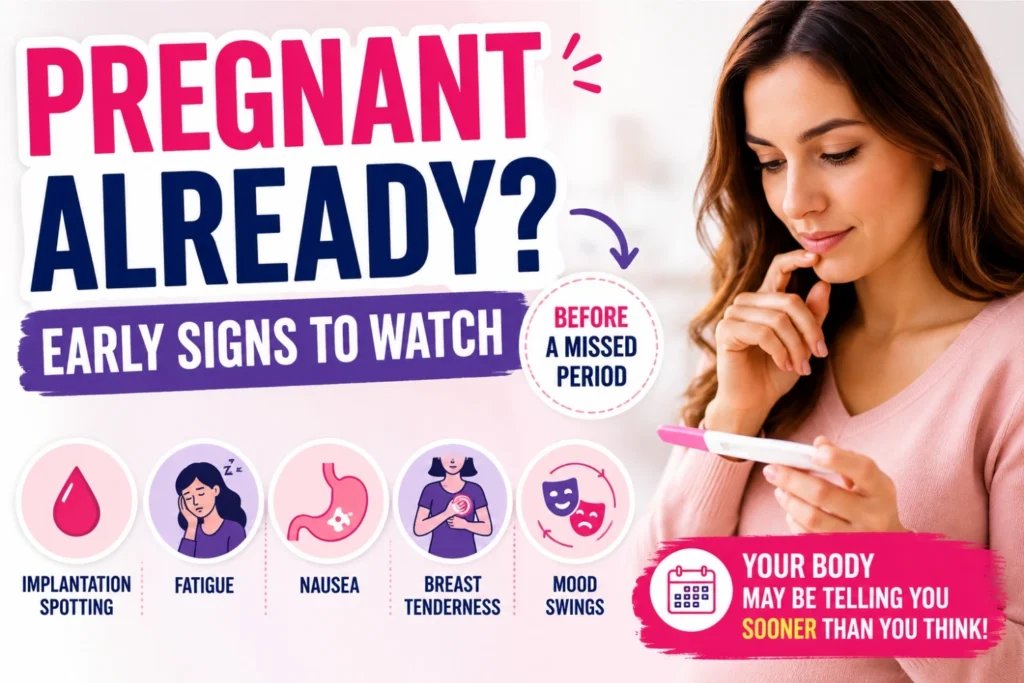
Most people associate pregnancy confirmation with a missed period and a positive test. The reality is that the body starts signalling much earlier. Some women notice changes within the first one to two weeks after conception, well before any test would show a result. Knowing what to look for makes a real difference.
Here is a breakdown of the early signs that could indicate pregnancy, starting from implantation itself.
What Is Implantation and Why Does It Matter?
Implantation is the moment a fertilised egg attaches to the lining of the uterus. It typically happens six to twelve days after ovulation. This is the point at which pregnancy technically begins, and it is also the point at which the body starts responding.
The process triggers hormonal changes, specifically a rise in hCG (human chorionic gonadotropin), which is the hormone pregnancy tests detect. Those hormonal shifts are also what causes many of the early symptoms women notice before they even think to take a test.
Implantation Bleeding vs. a Normal Period
This is one of the most commonly misread signs. When the fertilised egg embeds into the uterine lining, some light bleeding or spotting can occur. Many women assume this is just an early or light period and move on without considering that it might be something else.
The difference comes down to a few things. Implantation spotting is typically much lighter than a period. It tends to be pink or brownish rather than bright red. It lasts anywhere from a few hours to a couple of days. A normal period, on the other hand, progressively increases in flow and follows a familiar pattern.
Timing matters too. Implantation bleeding usually appears around ten to fourteen days after ovulation, which can overlap with when a period is expected. That overlap is why so many women miss it entirely or misread it.
If the spotting is unusually light, shorter than a typical period, and accompanied by other symptoms on this list, it is worth paying attention to.
Fatigue That Feels Different
Early pregnancy fatigue is not the same as being tired after a long day. It is a heavier, more persistent exhaustion that can show up even after a full night of sleep. Progesterone levels rise significantly in early pregnancy, and that hormonal shift slows the body down in a way that feels noticeably different from regular tiredness.
Some women describe it as feeling physically weighed down or struggling to stay alert during tasks that normally require no effort. This symptom can appear as early as one to two weeks after conception. If fatigue is arriving at an unusual time in the cycle and does not improve with rest, that is worth noting.
Mood Swings and Emotional Sensitivity
Hormonal fluctuations in early pregnancy affect the brain directly. Oestrogen and progesterone influence neurotransmitter activity, which is why emotions can feel more intense or unpredictable than usual. Some women find themselves tearing up at things that would not normally affect them. Others experience irritability or heightened anxiety without an obvious cause.
This symptom is easy to dismiss as stress or PMS. The distinction is that in early pregnancy, the emotional shifts tend to feel more abrupt and less connected to external circumstances.
Changes in Appetite and Food Cravings
An increase or decrease in appetite in the days following ovulation can signal that hormonal changes are underway. Some women develop strong aversions to foods they normally enjoy. Others notice cravings, particularly for specific textures or flavours, appearing out of nowhere.
Nausea can begin earlier than most people expect. The common assumption is that morning sickness starts around six weeks, but some women experience queasiness as early as two to three weeks after conception. It does not always present as actual vomiting. A persistent low-level nausea, especially in the morning or around certain smells, is a recognisable early sign.
Dr. Sophia Umair Bajwa covers these early symptoms in detail on her YouTube channel, including how to distinguish between PMS-related appetite changes and those tied to early pregnancy. Her content is clinically accurate and explained in a way that is easy to follow for anyone trying to understand what their body is doing.
Breast Tenderness and Sensitivity
Breast changes in early pregnancy can be noticeable within the first week or two after conception. The breasts may feel sore, heavier, or unusually sensitive to touch. The areolas can darken slightly. These changes are driven by rising oestrogen and progesterone levels preparing the body for potential pregnancy.
This symptom is also associated with PMS, which makes it another easy one to overlook. The key difference is intensity and timing. Pregnancy-related breast tenderness often starts earlier in the cycle and tends to be more pronounced.
Basal Body Temperature and the Implantation Dip
Women who track their basal body temperature (BBT) may notice a pattern called the implantation dip. This refers to a brief drop in temperature around the time of implantation, followed by a sustained rise. Normally, BBT rises after ovulation and stays elevated if pregnancy occurs. A sharp but temporary dip within that elevated phase can indicate implantation.
This is not universal. Not every pregnant woman experiences a measurable dip, and not every dip means pregnancy. For those who track consistently, it is a useful additional data point.
When to Take a Pregnancy Test
Taking a test too early is the most common mistake. Testing before enough hCG has accumulated in the body produces a false negative, which causes unnecessary confusion. Most home pregnancy tests are reliable from the first day of a missed period onward.
For the most accurate result, testing first thing in the morning gives the highest concentration of hCG in the urine. If the result is negative but symptoms persist and a period does not arrive, retesting a few days later is a reasonable next step.
Frequently Asked Questions
Can pregnancy symptoms appear before a missed period? Yes. Implantation-related symptoms such as spotting, fatigue, and breast tenderness can begin as early as six to twelve days after ovulation, before a period would be due.
Is implantation bleeding always present? Not for every woman. Some experience noticeable spotting. Others have no bleeding at all. The absence of implantation bleeding does not rule out pregnancy.
How soon can a blood test detect pregnancy? A blood test measuring hCG can detect pregnancy earlier than a urine test, sometimes as early as six to eight days after ovulation. A fertility specialist can order this if there is clinical reason to test early.
Experiencing These Symptoms? Visit Family Fertility & IVF Center
If these symptoms are present and conception has been an active goal, or if there have been repeated early losses or difficulty conceiving, a proper clinical evaluation makes more sense than repeated home testing.
Family Fertility & IVF Center in Lahore offers comprehensive reproductive health assessments, early pregnancy monitoring, and fertility treatment for women and couples at every stage of their journey. As one of the best IVF centers in Lahore, Pakistan, the clinic provides evidence-based care tailored to individual situations.
Dr. Sophia Umair Bajwa and the team at Family Fertility & IVF Center are available for consultations and can provide clarity on symptoms, cycle tracking, and next steps based on a thorough clinical review.
Have a question this post did not cover? Leave a comment below or drop it on the YouTube video. Reader questions directly shape future content, so specific queries are always welcome.