
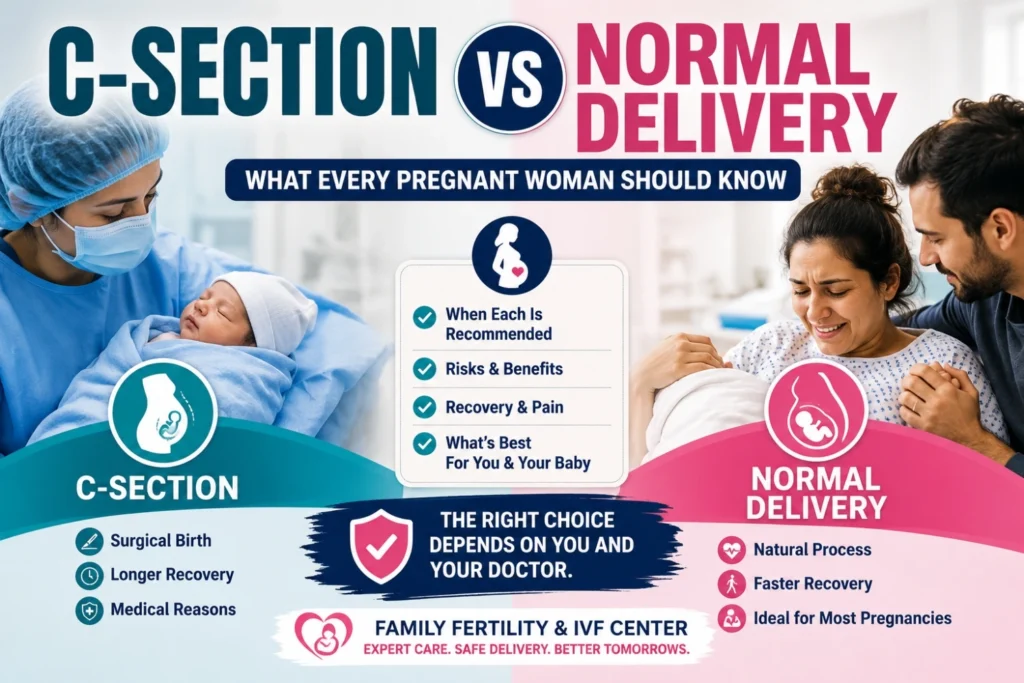
Normal delivery works with the body’s natural labor process and C-section is a surgical birth used when vaginal delivery isn’t safe for mother or baby.
Neither option is better on its own. The right choice depends on a person’s health conditions, and that decision should always sit with a qualified doctor.
Before believing everything you hear in hospital waiting rooms or family WhatsApp groups, read this blog. It answers the most common questions about normal delivery and C-sections with clear, expert-backed explanations.
1. What Happens During Normal Delivery
Normal delivery, also called vaginal birth, happens when the baby passes through the birth canal without surgical intervention. The body does the work through contractions, and the mother pushes when the cervix is fully dilated.
It’s the delivery method the human body is built for, and in low-risk pregnancies, it usually comes with a faster physical recovery.
1.1 The Three Stages of Labor
Labor moves through three distinct stages.
- Early and active labor: the cervix dilates from 0 to 10 centimeters, contractions grow stronger and closer together
- Delivery of the baby: pushing begins once dilation is complete
- Delivery of the placenta: this happens within 5 to 30 minutes after birth
Each stage varies in length. First-time mothers often go through longer labor, sometimes 12 to 18 hours, while later pregnancies tend to move faster.
1.2 Who Can Safely Have a Vaginal Birth?
Most healthy pregnancies without complications are suited for vaginal delivery. Doctors generally recommend it when:
- The baby is in a head-down position
- There’s no placenta previa or similar structural issue
- The mother has no active infections that could pass to the baby during birth
- Labor is progressing at a normal pace
2. What Is a C-Section
A Cesarean section is a surgical procedure where the baby is delivered through incisions made in the abdomen and uterus. It takes around 45 minutes from start to finish, though the actual delivery of the baby often happens within the first 10 minutes.
2.1 Planned vs Emergency C-Section
A C-section can be scheduled ahead of delivery or decided on the spot.
Planned C-sections happen when a known condition makes vaginal birth risky, and the date is set in advance. Emergency C-sections happen when something changes during labor and quick action becomes necessary to protect the mother or baby.
Unbooked emergency cases are especially tricky. These involve women arriving at the hospital with no prior medical record, which leaves doctors making high-stakes decisions with limited information and very little time.
2.2 Medical Reasons Doctors Recommend Surgery
Doctors don’t recommend surgery casually. Common reasons include:
- Breech position, where the baby is positioned feet or buttocks first
- Placenta previa, where the placenta covers the cervix
- Fetal distress, shown through an abnormal heart rate
- Multiple pregnancies, such as twins in unfavorable positions
- Prolonged labor that isn’t progressing despite strong contractions
- Prior C-sections combined with certain uterine scar types
3. Normal Delivery vs C-Section: A Complete Comparison
Both methods bring the same outcome, a baby. But the path there, and what follows, differs significantly.
3.1 Recovery Timeline
Vaginal delivery recovery generally takes 4 to 6 weeks. Most women can walk within hours and manage basic tasks within a few days.
C-section recovery takes longer, usually 6 to 8 weeks, since it involves healing from major abdominal surgery. Lifting, driving, and stair climbing often need to wait until the incision heals properly.
3.2 Risks on Both Sides
Vaginal birth carries risks like perineal tearing, prolonged labor, and in rare cases, the need for an emergency C-section mid-labor.
C-sections carry surgical risks including infection, blood clots, and longer hospital stays. Global data consistently shows that maternal complication rates run higher with C-sections compared to uncomplicated vaginal births, which is exactly why doctors avoid surgery unless there’s a clear medical reason.
3.3 Effect on Future Pregnancies
A woman who has had one C-section can often still deliver vaginally in a later pregnancy, a process called VBAC (vaginal birth after cesarean). Success depends on the type of uterine incision and how the previous surgery healed.
Multiple C-sections do raise the risk of placenta-related complications in later pregnancies, which is a factor doctors weigh carefully when family size plans come into the conversation.
4. Anesthesia During Childbirth
Pain management during delivery brings its own set of questions, and a fair share of myths.
4.1 Spinal Block vs General Anesthesia
Spinal anesthesia numbs the lower body while the mother stays awake, and it’s the standard choice for planned C-sections. General anesthesia puts the mother fully under and gets reserved for true emergencies, since it carries more risk for both mother and baby.
4.2 Popular Myths
One persistent myth claims spinal anesthesia causes permanent back pain. It doesn’t. Mild soreness at the injection site can happen, but it resolves within days, not years.
General anesthesia, by contrast, is actually the higher-risk option in non-emergency situations, since it affects the baby’s alertness at birth and increases recovery time for the mother.
5. Family Pressure and Delivery Decisions
Cultural expectations around childbirth run deep in Pakistani households. Family members, often mothers-in-law, push back against C-sections, viewing vaginal birth as the “real” or preferred option.
This pressure puts mothers and doctors in a difficult position. A delivery decision should rest on medical safety, not family opinion or tradition. When a doctor recommends a C-section, it’s because data, monitoring, and clinical judgment point that way, not because of convenience.
6. How Doctors Decide
The decision-making process looks at several factors together: the baby’s position, heart rate patterns, the mother’s health history, and how labor is progressing in real time.
Doctors also weigh the mother’s overall safety alongside the baby’s. In emergencies, especially unbooked cases with no prior records, speed becomes the priority, and a C-section is often the fastest path to a safe outcome for both.
Frequently Asked Questions
Is normal delivery better than C-section? Neither is universally better. Vaginal delivery suits low-risk pregnancies, while a C-section becomes the safer route when specific medical conditions exist.
How painful is a C-section recovery compared to normal delivery? C-section recovery involves surgical pain at the incision site and takes longer overall. Vaginal delivery recovery is generally quicker but can include perineal soreness.
Does spinal anesthesia cause long-term back pain? No. This is a common misconception. Any soreness from the injection site fades within a few days.
What are the signs that a C-section might be needed? Breech position, fetal distress, placenta previa, and labor that stops progressing are among the most common indicators.
Are C-sections becoming more common worldwide? Yes. Many countries report C-section rates well above the 10 to 15 percent range considered medically necessary by global health bodies, largely due to a mix of medical and non-medical factors.
Can I have a normal delivery after a previous C-section? Often yes, through VBAC, depending on the incision type from the earlier surgery and how the uterus healed.
Book a Consultation Today with Our Specialists
Delivery decisions carry weight, and they deserve information, not assumptions passed around at family gatherings. Dr. Sophia Umair Bajwa covers these topics in detail on her YouTube channel, walking through clinical scenarios that make the medical side easier to understand.
Got a question that wasn’t answered here? Drop it in the comments below or under Dr. Sophia Umair Bajwa’s video, and it may end up shaping a future blog or video.
For expert guidance on delivery planning, fertility treatment, or pregnancy care, Family Fertility & IVF Center in Lahore is a trusted choice, known as one of the top IVF centers in Lahore, Pakistan, and recognized for combining medical expertise with modern fertility technology.