
Genetic testing before embryo transfer sounds confusing. It kind of is, honestly. But understanding the basics can change how you approach each step of IVF.
In Pakistan, this kind of specialized testing is still relatively new. Many biopsies actually get sent overseas for detailed reporting. That’s simply where the technology currently stands.
Let’s break it down, test by test, so it finally makes sense.
Why Genetic Testing Happens at All
After an embryo is created during IVF, a small biopsy can be taken from it. This sample gets tested before the embryo is transferred into the uterus.
The goal is simple. Identify healthy embryos before transfer, rather than after a failed attempt or, worse, after a miscarriage.
There are three main types of testing, and each serves a different purpose.
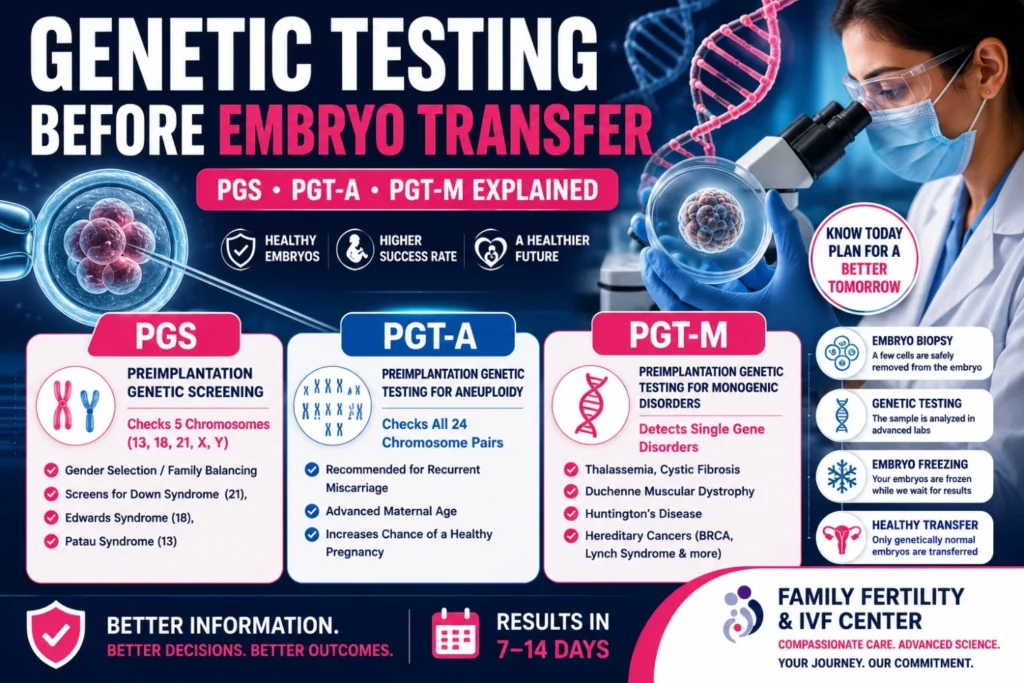
PGS: Preimplantation Genetic Screening
This is often used by couples interested in gender selection or family balancing.
PGS looks at five specific chromosomes: 13, 18, 21, X, and Y. This allows doctors to determine the embryo’s gender while also screening for well-known chromosomal conditions.
These include Down syndrome, Edwards syndrome, and Patau syndrome. All three are linked to specific chromosomal abnormalities that PGS can detect early.
PGT-A: Preimplantation Genetic Testing for Aneuploidy
This test goes further than PGS. Instead of checking five chromosomes, it examines all 24 chromosome pairs.
PGT-A is typically recommended for couples with a history of recurrent miscarriage, or for women of advanced maternal age.
Why does this matter so much? Because a large percentage of miscarriages happen due to chromosomal abnormalities that aren’t visible just by looking at an embryo under a microscope.
By selecting only chromosomally normal embryos, PGT-A significantly improves the odds of a successful, ongoing pregnancy.
PGT-M: Preimplantation Genetic Testing for Monogenic Disorders
This one is designed specifically for families with a known history of inherited genetic diseases.
PGT-M can identify embryos carrying genes for conditions like thalassemia, cystic fibrosis, Duchenne muscular dystrophy, and Huntington’s chorea.
It also covers hereditary cancer syndromes, including Lynch syndrome and BRCA gene mutations.
For families where these conditions run in the bloodline, PGT-M offers a way to significantly reduce the risk of passing them on to the next generation.
Preparing Yourself for the Wait
The gap between biopsy and results can feel like the longest part of the entire cycle.
Your embryos are frozen and safe during this time. Nothing is at risk while you wait, even though the waiting itself feels stressful.
Use this window to prepare questions for your doctor rather than spiraling into worst-case scenarios. Ask in advance how results will be shared, and what the next steps look like for each possible outcome.
Does Genetic Testing Guarantee a Successful Pregnancy?
This is an important expectation to set early. No, it doesn’t.
Genetic testing improves the odds significantly by ruling out chromosomally abnormal embryos. But implantation still depends on other factors too, like the uterine lining, hormone levels, and overall uterine health.
Think of it as removing one major variable, not eliminating every possible obstacle. A chromosomally normal embryo still needs the right environment to implant and grow successfully.
How Many Embryos Typically Get Tested?
This depends entirely on how many embryos reach the blastocyst stage during your cycle.
Some patients only have one or two viable embryos to test. Others, especially younger patients or those with a strong ovarian response, may have several.
More embryos to choose from generally means better odds of finding at least one chromosomally normal option. But even a single tested embryo provides valuable information your doctor can act on.
Which Test Is Right for You?
This depends entirely on your specific situation, and it’s not a one-size-fits-all decision.
If you’re dealing with recurrent pregnancy loss or are of advanced maternal age, PGT-A is usually the more relevant option.
If your family has a documented history of a specific genetic condition, PGT-M becomes the more targeted choice.
If gender balancing or basic chromosomal screening is your priority, PGS may be sufficient.
A proper consultation with your fertility specialist will help determine which path actually applies to your case. This isn’t a decision to make based on internet research alone.
What the Testing Process Looks Like
Here’s the practical side, since a lot of patients feel nervous about the unknown.
An embryo reaches the blastocyst stage, usually around day five or six of development. A small number of cells are gently removed from the outer layer, a part that eventually forms the placenta, not the baby itself.
This biopsy sample gets frozen along with the embryo while results are pending. Once genetic reporting comes back, usually within one to two weeks, doctors know exactly which embryos are safe to transfer.
Because testing labs are still developing locally, many samples travel overseas for analysis. This does add some waiting time, but it doesn’t compromise accuracy.
Understanding the Cost Conversation
Genetic testing adds a cost on top of a standard IVF cycle. It’s a fair question to ask upfront, rather than being surprised later.
For many couples, especially those with recurrent loss or advanced maternal age, the cost is worth it. Avoiding a failed transfer, or worse, a miscarriage, often saves both money and emotional strain in the long run.
For others, particularly younger couples with no red flags in their history, skipping testing may be a reasonable choice. This is exactly the kind of decision worth discussing openly with your doctor, rather than assuming one option fits everyone.
The Emotional Side of Genetic Testing
Here’s something that doesn’t get discussed enough. Genetic testing can bring up complicated emotions.
Waiting for results feels agonizing. Learning that some embryos aren’t viable can be heartbreaking, even when it’s ultimately protective information.
It helps to have a doctor who explains results clearly, without rushing through complicated genetic terminology. You deserve clarity, not just data.
What Happens if No Embryos Test Normal?
This is a hard scenario, but one worth preparing for mentally.
Sometimes, out of several tested embryos, none come back chromosomally normal. This is more common with advanced maternal age or certain underlying conditions.
If this happens, your doctor should discuss next steps clearly. This might mean another retrieval cycle, adjusted protocols, or additional testing to understand why. It doesn’t necessarily mean pregnancy isn’t possible, but it does mean the plan needs to change.
Why the Right Lab Matters Here
Since testing accuracy depends heavily on lab standards, choosing a clinic with strong lab protocols and reliable reporting partnerships matters enormously.
A biopsy that’s mishandled, or results that get miscommunicated, can lead to real consequences. This isn’t a step to take lightly or rush through.
Dr. Sophia Umair Bajwa explains these three testing types in detail on her YouTube channel, walking through exactly which patients benefit from each option and why.
For couples in Lahore exploring genetic testing before their embryo transfer, Family Fertility & IVF Center works directly with trusted labs to ensure results are accurate and clearly explained.
Not sure which test applies to your situation? Ask away, here in the comments or under the related video, and we’ll figure it out together.