
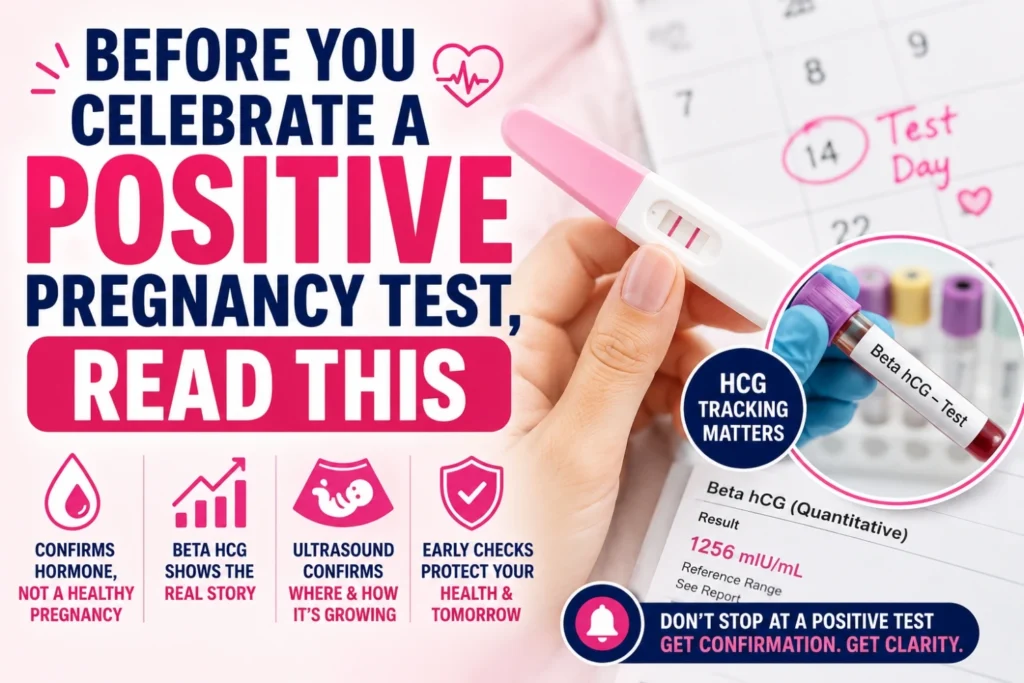
A positive pregnancy test confirms hormone activity. Not a healthy pregnancy. That confirmation only comes after Beta HCG blood levels are tracked properly.
At Family Fertility & IVF Center, this is one of the most common questions patients bring in after seeing two lines on a home test.
This blog explains what a positive pregnancy test means, why monitoring Beta HCG levels is important, and the early warning signs you shouldn’t ignore. Read it before assuming everything is progressing normally.
1. What Does a Positive Pregnancy Test Mean?
A positive test means HCG hormone is present in the body. It does not confirm the pregnancy is inside the uterus, growing correctly, or even continuing.
Many women stop paying attention right after that positive result. That is exactly where problems can go unnoticed.
1.1 Urine Test vs Blood Test
Urine tests give a yes or no answer. Blood tests measure the exact Beta HCG number and show whether it is rising the way it should.
A single number means very little on its own. The trend across days tells the real story.
2. What Is Beta HCG and Why Does It Matter?
Beta HCG is a hormone produced once pregnancy begins. In someone who is not pregnant, this hormone sits at essentially zero.
Once conception happens, HCG enters the bloodstream and climbs steadily during the first weeks. Doctors track this rise to judge whether a pregnancy is progressing on schedule.
2.1 Normal Beta HCG Behavior in Early Pregnancy
In a healthy early pregnancy, Beta HCG typically doubles roughly every 48 to 72 hours during the first few weeks. This pattern is one of the clearest early signs that things are on track.
A slow rise, a plateau, or a drop can point to complications long before symptoms appear. This is why a single positive test should always be followed with lab work, not just excitement.
3. What If Beta HCG Is Rising but the Ultrasound Shows Nothing?
This combination needs urgent attention. It can mean the pregnancy has not yet reached a visible stage, or it can point to something more serious.
3.1 Understanding Ectopic Pregnancy Risk
An ectopic pregnancy happens when the fertilized egg implants outside the uterus, most often in a fallopian tube. If Beta HCG keeps rising but ultrasound cannot locate a pregnancy inside the uterus, doctors treat this as a possible ectopic case until proven otherwise.
Ectopic pregnancy can become life threatening if left untreated. Early detection through Beta HCG tracking gives doctors the window needed to act before rupture or internal bleeding occurs.
Doctors usually expect to see a pregnancy on ultrasound once HCG crosses a certain threshold. If that milestone is missed, further blood work and scans follow immediately.
4. How Long Should Beta HCG Be Monitored?
Monitoring continues until pregnancy is confirmed inside the uterus and a fetal heartbeat is detected on ultrasound. Stopping before that point leaves too much room for missed complications.
4.1 After a Miscarriage or Biochemical Pregnancy
If a pregnancy ends early, whether through miscarriage or a biochemical pregnancy, Beta HCG needs to be followed down to zero. This step often gets skipped, and skipping it carries real risk.
Retained tissue or, in rare cases, conditions like molar pregnancy and choriocarcinoma can keep HCG elevated even after a loss. Confirming the hormone reaches nil rules these complications out.
Quick checklist for post loss monitoring:
- Repeat Beta HCG every few days until it drops
- Continue until levels reach zero, not just “low”
- Report any unusual bleeding, pain, or symptoms immediately
- Do not assume a completed miscarriage without lab confirmation
5. Does This Apply to IUI and IVF Pregnancies Too?
Yes, and arguably more so. If conception happened naturally, through IUI, or through IVF, the same Beta HCG monitoring rules apply.
IVF pregnancies are often watched even more closely since the process itself carries a slightly higher chance of ectopic implantation and early pregnancy loss. Fertility specialists usually schedule the first Beta HCG test around 10 to 14 days after embryo transfer, followed by a repeat test 48 hours later.
Dr. Sophia Umair Bajwa regularly stresses this point with patients going through fertility treatment. The emotional investment in IUI and IVF makes it tempting to celebrate early, but lab confirmation should always come first.
Quick Summary
- A positive test confirms HCG, not a healthy pregnancy
- Beta HCG should roughly double every two to three days early on
- Rising HCG without a visible pregnancy on ultrasound can signal ectopic pregnancy
- After any pregnancy loss, HCG must be tracked to zero
- IUI and IVF pregnancies need the same monitoring, sometimes closer
Frequently Asked Questions
How soon can Beta HCG detect pregnancy? Blood tests can pick up Beta HCG around 8 to 11 days after conception, often before a home urine test turns positive.
What is a normal Beta HCG level in early pregnancy? Levels vary widely, but the pattern of rise matters more than the exact number. Doctors compare values across 48 to 72 hour intervals rather than judging a single reading.
Can Beta HCG be positive with an ectopic pregnancy? Yes. HCG will still rise with an ectopic pregnancy, just often at a slower rate than expected, which is why ultrasound correlation is essential.
Do IVF pregnancies need more frequent Beta HCG testing? Many fertility clinics recommend closer monitoring for IVF pregnancies given the added risk factors involved, though the core testing principles stay the same as any pregnancy.
Does a miscarriage always show a sudden drop in Beta HCG? Not always. Levels can decline gradually, so repeat testing until the hormone reaches zero is the only reliable way to confirm the pregnancy has fully ended.