
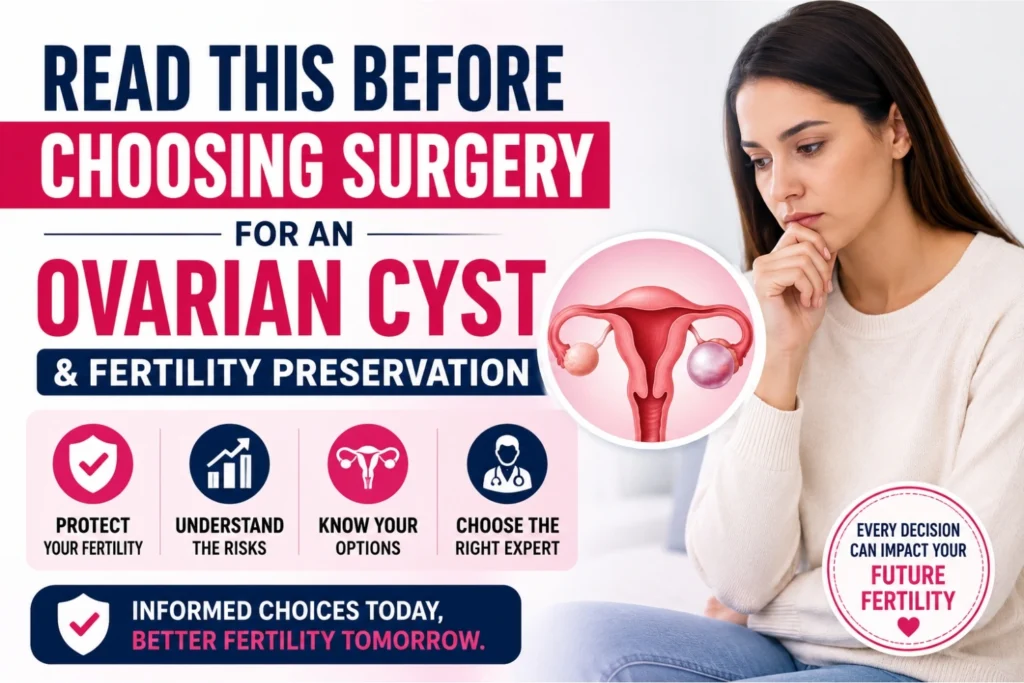
Getting diagnosed with an ovarian cyst and being told you need surgery in the same breath is more common than it should be. Many women walk out of that appointment with a surgery date already scheduled, never having asked whether the operation was truly necessary or what it might cost them reproductively.
That cost is real. And for women who want children, whether now or years from now, understanding it before surgery is not optional.
What Your Ovarian Reserve Says About Future Fertility
Ovarian reserve is the measure of how many eggs a woman has left and how healthy they are. The key hormone that reflects this is AMH (Anti-Müllerian Hormone). Doctors use AMH levels to assess where a woman stands reproductively at any given age.
Ovarian reserve declines naturally over time. A woman at thirty-five has a significantly lower reserve than she did at twenty-five. By the early forties, the decline is steep. This is expected and normal.
What is not normal is a surgical procedure speeding up that decline. Poorly performed ovarian cyst surgery can do exactly that, and the drop in AMH afterward can be significant enough to affect a woman’s ability to conceive naturally.
How Ovarian Surgery Can Damage Healthy Egg Tissue
During a cystectomy, the goal is to remove the cyst while leaving the ovary intact and functional. In practice, this is where things go wrong if the surgeon is not experienced in fertility-sparing techniques.
The ovarian cortex is the outer layer of the ovary. This is where follicles containing eggs are stored. It is thin, delicate, and very easy to damage. Surgical energy tools used carelessly can cause thermal damage to this tissue. The process of separating the cyst from the ovary, if done without precision, strips away healthy follicle-containing tissue along with the cyst wall.
The result shows up in bloodwork. AMH drops. Ovarian reserve is reduced. And for a woman in her late thirties, that reduction can be the difference between conceiving naturally and needing IVF. For a younger woman who is not thinking about children yet, it quietly narrows her future options before she ever gets to use them.
Not All Ovarian Cysts Need Surgery
This is one of the most under-discussed facts in this conversation. A cyst on an ultrasound report does not automatically require a surgery date.
Functional Cysts
These form as a routine part of the menstrual cycle. Follicular cysts and corpus luteum cysts are extremely common and typically resolve on their own within one to three cycles. Operating on these is rarely justified.
Small Endometriomas
Endometriomas, also called chocolate cysts, are caused by endometriosis. In younger women with good ovarian reserve and manageable symptoms, conservative management can be the right call. Aggressive surgical removal of these cysts often damages ovarian tissue more than the cyst itself would have.
Simple, Asymptomatic Cysts
A small, simple cyst in a woman with no symptoms and normal bloodwork does not need immediate removal. Monitoring with serial ultrasounds over a few months is the medically sound approach. Many of these resolve completely without any intervention.
Size, cyst type, symptoms, age, and fertility plans all need to factor into the decision. The presence of a cyst alone is never a sufficient reason to operate.
When Doctors Recommend Surgery for Good Reason
Some cysts genuinely need surgical management. Avoiding surgery in these cases carries its own risks.
Complex or Suspicious Cysts
Cysts with solid components, irregular walls, rapid growth, or internal blood flow on Doppler imaging require closer evaluation and typically need to come out.
Ovarian Torsion
Very large cysts can cause the ovary to twist on its blood supply. This is a medical emergency. Prompt surgery is necessary to save the ovary.
Dermoid Cysts
These do not resolve on their own. They grow slowly and will eventually need to be removed. With the right surgical approach, the impact on ovarian reserve can be minimized.
Large or Symptomatic Endometriomas
When endometriomas are causing significant pain, growing in size, or directly affecting fertility, surgery becomes appropriate. Even then, the decision needs to be made carefully with the patient’s ovarian reserve in mind.
Laparoscopic Surgery Causes Less Damage to Fertility
Laparoscopic surgery is the current standard for ovarian cyst removal. Compared to open surgery, it causes significantly less trauma to surrounding tissue, involves smaller incisions, reduces recovery time, and lowers the risk of adhesion formation.
Adhesions are bands of internal scar tissue that develop after any surgery. In the pelvis, they can distort the fallopian tubes, interfere with ovulation, and make natural conception difficult even when the ovaries are still producing eggs. Laparoscopy keeps this risk much lower than open surgery does.
For reproductive-age women, a laparoscopic approach performed by a skilled surgeon is the option that best protects long-term fertility.
Choosing the Right Surgeon Changes Fertility Outcomes
Two surgeons can perform the exact same operation on the exact same type of cyst and produce very different outcomes for ovarian reserve. This is not a minor variable.
A fertility specialist operating on a reproductive-age woman approaches the procedure differently than a general gynecologist would. The focus is not just on removing the cyst successfully. It is on how much healthy ovarian cortex can be preserved, how much thermal damage can be avoided, and how precisely the cyst wall can be separated from the surrounding ovarian tissue without taking follicles along with it.
These are the decisions that determine whether AMH levels hold steady or drop after surgery.
Dr. Sophia Umair Bajwa, a reproductive specialist at Family Fertility & IVF Center in Lahore, has addressed this issue directly in her educational content. Her point is straightforward: ovarian cyst surgery in women of reproductive age must be approached with fertility preservation built into the plan from the start, not treated as a secondary consideration. Her YouTube channel is a genuinely useful resource for any woman trying to understand this before she agrees to anything.
Fertility Protection Should Be Part of Every Ovarian Surgery
Preserving ovarian function during cyst surgery means more than just leaving the ovary in place. It means leaving it working.
Surgeons with fertility-sparing expertise will:
- Limit electrocautery use near the ovarian cortex to prevent heat damage to follicles
- Use precise dissection to separate the cyst wall from ovarian tissue without tearing
- Irrigate the surgical site thoroughly to clear blood and debris
- Avoid removing healthy ovarian tissue alongside the cyst
- Assess the remaining ovarian tissue before closing
None of this adds unreasonable time to the procedure. It does require a surgeon who is specifically trained in reproductive surgery and who treats fertility preservation as a clinical priority.
Young and Unmarried Women Need to Pay Attention Too
The women most likely to dismiss this information are young women who are not currently thinking about having children. This is also the group that stands to lose the most from a poorly performed cyst surgery.
Ovarian reserve damage at twenty-two does not announce itself immediately. It shows up at thirty-two when a woman is actually ready to conceive and finds out her AMH is lower than expected for her age. The connection to a surgery done years earlier often gets missed entirely.
Dr. Sophia Umair Bajwa has specifically highlighted this in her work, noting that young patients are often the least informed about the reproductive risks of ovarian surgery and the most in need of proper guidance before consenting to a procedure.
Ask These Questions Before You Agree to Surgery
Before any ovarian cyst surgery, these questions deserve real answers:
- Does this cyst actually need to be removed now, or is observation a reasonable option?
- What type of cyst is this, and how is it likely to behave over time?
- What is the current AMH level, and what is the realistic risk to ovarian reserve from surgery?
- Will the procedure be done laparoscopically?
- Does the surgeon have specific experience in fertility-sparing ovarian surgery?
- What steps will be taken during surgery to protect the ovarian cortex?
If the answers are vague or the questions are brushed off, a second opinion from a reproductive specialist is entirely warranted.
Don’t Risk Your Fertility. Consult the Right Specialist First
For women in Pakistan seeking specialized reproductive care, Family Fertility & IVF Center in Lahore is a trusted resource for exactly these situations. The team brings a fertility-first perspective to ovarian cyst management, helping patients understand their options clearly before making any decisions.
Have a question this blog did not cover? Drop it in the comments below or post it on the Dr. Sophia Umair Bajwa YouTube channel. Topics raised by viewers regularly shape future videos and content. If something is on your mind, put it out there.
Ovarian cysts are manageable. Preventable damage to ovarian reserve, caused by the wrong surgery or the wrong surgeon, is not something any woman should have to deal with.