
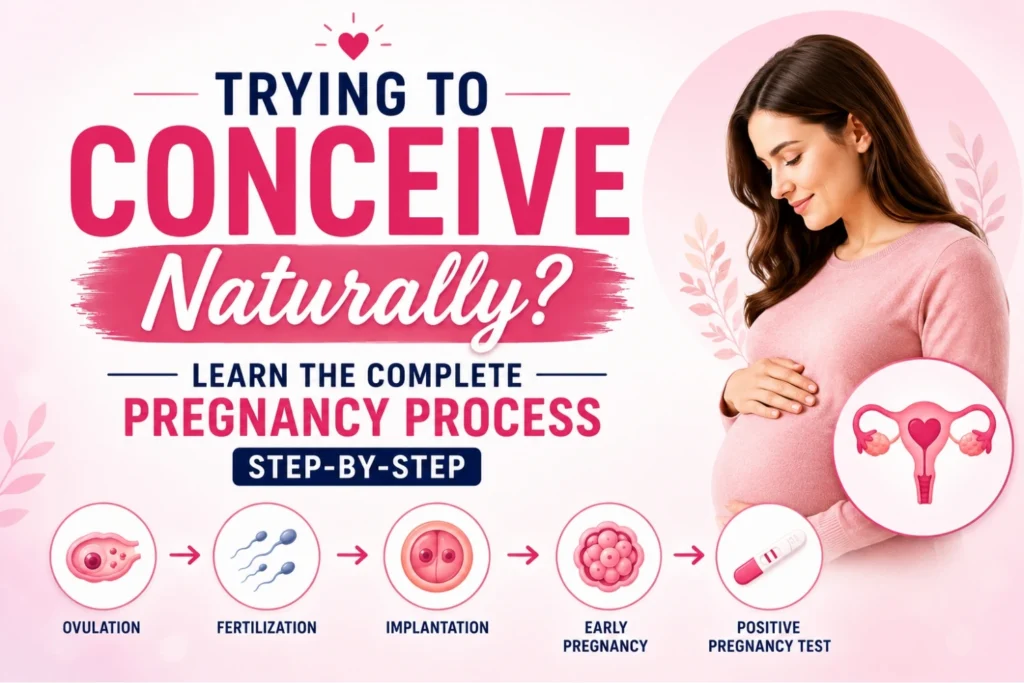
Every woman who has ever searched “how to get pregnant naturally” at 2 AM knows the feeling of wanting clear answers but finding only confusion instead. Countless tabs. Conflicting information. Medical jargon that somehow makes a natural biological process sound like rocket science. So here is the full picture, explained the way it should have been from the start.
How Your Body Gets Ready Each Month
The journey to pregnancy starts long before any sperm enters the picture. Every month, the female body runs a precise hormonal cycle designed with one purpose: preparing for a potential pregnancy.
What Actually Happens During Your Menstrual Cycle
The menstrual cycle is not just about periods. The period itself is simply the body clearing out a uterine lining that was not needed that month. The real action happens after it ends.
Around days two to five of the cycle, the brain signals the ovaries through hormones, specifically FSH (follicle-stimulating hormone). This triggers several follicles inside the ovary to begin growing. Each follicle contains an egg. Only one of these follicles will mature fully, while the others quietly fade.
As the dominant follicle grows, it produces estrogen. Estrogen does two important things: it thickens the uterine lining in preparation for a potential embryo, and it eventually triggers a surge of LH (luteinizing hormone) from the pituitary gland. That LH surge is what kicks off ovulation.
The Most Important Fertility Window
When Does Ovulation Occur?
In a standard 28-day cycle, ovulation typically happens around day 14. The reality is that cycles vary, and ovulation timing shifts with them. Some women ovulate on day 10. Others on day 18. Tracking ovulation is therefore not optional for anyone serious about conceiving.
Signs of ovulation include a slight increase in basal body temperature, changes in cervical mucus (it becomes clear and stretchy, similar to raw egg white), and for some women, a mild one-sided cramp called mittelschmerz.
The egg released during ovulation survives for only 12 to 24 hours. This is the window. Miss it, and conception does not happen that cycle.
Your Fertile Days May Last Longer
Here is something that surprises most people: sperm can survive inside the female reproductive tract for up to five days. This means the fertile window actually spans about six days, the five days before ovulation and the day of ovulation itself. Having intercourse on the days leading up to ovulation can be just as effective as timing it to the exact day.
The Sperm Side of the Story
Why Millions Are Needed for One to Succeed
This is the part that catches people off guard. A single ejaculation contains anywhere from 40 million to 300 million sperm. Out of all of those, only a few hundred even reach the fallopian tubes, and only one fertilizes the egg.
The journey sperm face is genuinely brutal. The vaginal environment is acidic and hostile to sperm survival. Cervical mucus during non-fertile phases acts as a barrier. The uterus itself creates physical obstacles. Sperm that are not motile enough, not shaped correctly, or simply lack the endurance to make the trip do not make it.
This is precisely why sperm count and motility matter so much in fertility assessments. A lower count significantly reduces the odds of even one sperm reaching the egg. If conceiving has been a challenge, a semen analysis is one of the first things to evaluate. At Family Fertility & IVF Center, this is one of the foundational assessments for couples facing difficulties.
How Fertilization Happens
What Happens Inside the Fallopian Tube
The egg does not sit in the uterus waiting. After ovulation, it is swept into the fallopian tube, where fertilization takes place. This is a detail many people do not know.
When a sperm reaches the egg in the fallopian tube, it must penetrate two protective layers: the corona radiata and the zona pellucida. This requires enzymes released from the sperm’s head. Once a single sperm breaks through and fuses with the egg, the egg immediately changes its outer layer to prevent any other sperm from entering.
At this point, the egg is officially fertilized. The resulting cell is called a zygote, and it contains 23 chromosomes from the egg and 23 from the sperm, forming the complete 46-chromosome human blueprint.
From Zygote to Blastocyst
The zygote does not stay a single cell. Over the next few days, it begins dividing: two cells, four cells, eight cells, and so on. As it divides, it slowly travels down the fallopian tube toward the uterus.
By day five or six after fertilization, it has developed into a blastocyst, a fluid-filled structure with an inner cell mass that will become the embryo, and an outer layer that will become the placenta.
The Process of Embryo Implantation
How the Embryo Attaches to the Uterus
Reaching the uterus is one milestone. Implanting successfully is another.
The blastocyst must attach to the uterine lining, called the endometrium. This lining has been thickening since the start of the cycle in preparation for exactly this moment. Implantation happens between days six and ten after fertilization.
For implantation to succeed, the endometrium needs to be receptive, which means the right hormonal environment must be in place. Progesterone, produced by the corpus luteum (the follicle that released the egg), plays a major role here.
Some women notice light spotting during implantation, often mistaken for an early period. This is called implantation bleeding, and it is completely normal.
When Does a Pregnancy Test Turn Positive?
Once the blastocyst implants, it begins producing hCG (human chorionic gonadotropin), the hormone that pregnancy tests detect. Levels of hCG double roughly every 48 to 72 hours in early pregnancy.
Most home pregnancy tests can detect hCG around the time of a missed period, which is about 14 days after ovulation. Testing too early often gives a false negative, since hCG levels may not be high enough to register.
When Natural Conception Needs Support
Understanding the full process also means understanding where things can go wrong. Irregular ovulation, low sperm count, fallopian tube blockages, hormonal imbalances, or an unreceptive uterine lining are all factors that can prevent natural conception.
Dr. Sophia Umair Bajwa has been a trusted name for couples facing these exact challenges. Her YouTube channel covers pregnancy, fertility, and women’s health topics in a way that is genuinely accessible, without the clinical detachment that makes most medical content hard to absorb. If this blog left any questions unanswered, her channel is worth exploring.
For couples who have been trying to conceive without success, the best IVF center in Lahore, Family Fertility & IVF Center, offers complete reproductive health evaluations and personalized treatment plans. From ovulation induction to IUI to full IVF cycles, the center handles every stage of the fertility journey with clinical precision and genuine care.
Dr. Sophia Umair Bajwa and the team at Family Fertility & IVF Center work together to ensure that every couple walking through their doors gets answers, not just appointments.
Visit Our Lahore Fertility Center for Trusted Support
Natural conception is a process with many moving parts, and every step has to work in coordination. The egg has to mature. Ovulation has to happen. Sperm has to survive the journey. Fertilization has to occur at the right time and place. The embryo has to travel, develop, and implant successfully. And then, finally, the hormonal signals have to sustain the pregnancy.
Most of the time, this process works beautifully on its own. When it does not, knowing what to look for makes all the difference.
Have a question about something covered here, or a topic you want to see explored next? Drop a comment on our YouTube video and the team will address it directly. The goal is always to make this information more accessible, one question at a time.For consultations and fertility treatments, visit Family Fertility & IVF Center in Lahore, the best IVF center in Lahore, Pakistan for couples seeking expert care.