
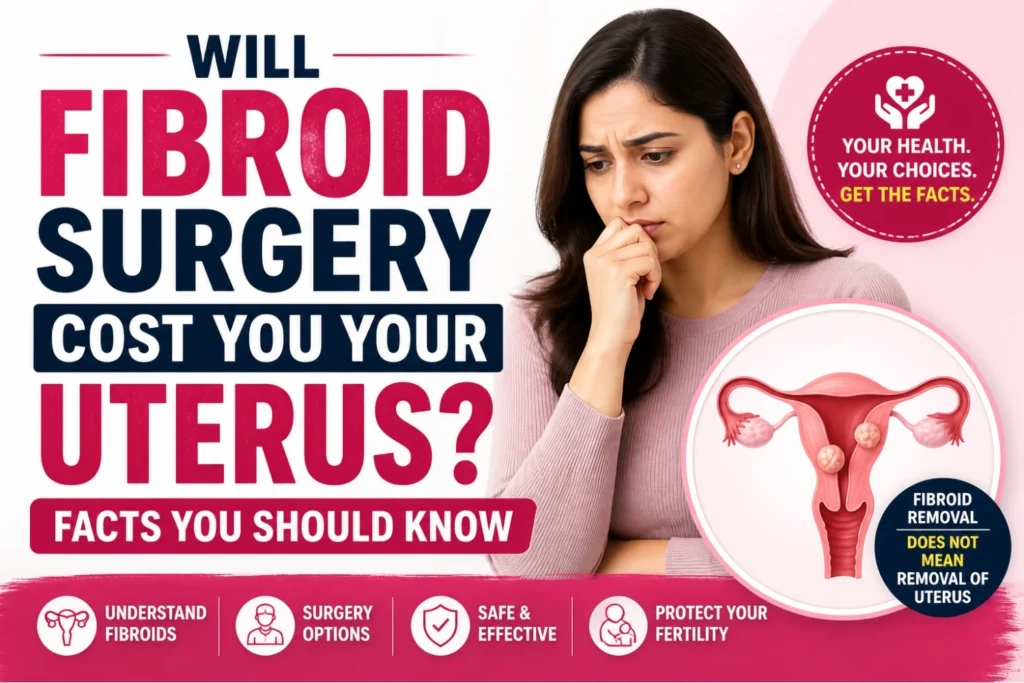
You find out you have fibroids. The doctor mentions surgery. And somewhere between that sentence and the drive home, your brain has already decided: they’re going to remove your uterus.
That fear spreads fast. It spreads through WhatsApp forwards, through half-remembered stories from aunties, through Google searches at 2 AM that somehow always lead to the worst possible outcome. And because of it, women are delaying treatment, avoiding consultations, and quietly watching their fertility window close. All over a fear that, in most cases, has no clinical basis whatsoever.
Fibroid surgery and uterus removal are not the same procedure. They have never been the same procedure. And the sooner that distinction becomes common knowledge, the better.
So What Even Are Fibroids?
Fibroids are non-cancerous growths that develop in or around the uterus. Completely benign. Extremely common. A huge number of women have them and never find out because the fibroids never cause symptoms.
The problem starts when they do. Heavy bleeding that disrupts daily life. Pelvic pain that medication barely touches. A uterine cavity so distorted that pregnancy becomes genuinely difficult. That is when fibroids stop being a silent passenger and start being an actual clinical problem.
How Fibroids Mess with Fertility
Location is everything here. A fibroid sitting quietly on the outer wall of the uterus is very different from one pressing into the cavity where an embryo needs to implant.
Submucosal fibroids bulge directly into the uterine cavity and are the most disruptive to fertility. They interfere with implantation, raise miscarriage risk, and can turn an otherwise straightforward IVF cycle into a repeated failure. Intramural fibroids that distort the cavity wall cause similar issues. Size matters too. A small fibroid in a neutral position is a very different conversation from a large one sitting exactly where it should not be.
This is why a proper ultrasound or MRI before any treatment decision is non-negotiable. You cannot make a call without knowing what you are actually dealing with.
When Does Fibroid Surgery Make Sense?
Here is the thing most people do not hear clearly enough: surgery is not the automatic response to a fibroid diagnosis. Many fibroids are monitored and never touched. Surgery becomes the recommendation when fibroids are actively causing problems that nothing else can fix.
Clear Signs You Need Surgery
Bleeding so heavy it is affecting quality of life and iron levels. Chronic pelvic pain with no other explanation. A uterine cavity that is too distorted for embryo implantation. Repeated miscarriages where fibroid position is the most likely factor. Failed IVF cycles where the uterus is the issue.
In these situations, removing the fibroid is not an aggressive or drastic decision. It is the most direct path to fixing the actual problem.
Uterus Removal: Myth vs Reality
The surgery that removes the uterus is a hysterectomy. The surgery that removes fibroids while keeping the uterus completely intact is called a myomectomy. Two different procedures. Two different outcomes. Two very different conversations.
Fertility specialists performing fibroid surgery are not in the business of removing uteruses. The entire goal of a myomectomy is to take out the fibroid and preserve the organ. Hysterectomy is not a backup plan that surgeons quietly default to.
What Is the Real Risk?
In the hands of an experienced fertility surgeon, the rate of unplanned hysterectomy during a myomectomy is under 1%. Under one percent. That number puts the fear in proportion very quickly.
Dr. Sophia Umair Bajwa, a fertility specialist who performs fibroid surgeries regularly, sees this fear walk through the door constantly. Women who arrive convinced they will leave the operating room without a uterus. The consultation usually looks very different from what they were expecting, because the facts look very different from what they had heard.
The outcome women fear the most is also statistically the least likely one. Provided the right surgeon is doing the procedure.
Types of Fibroid Surgery
The approach depends entirely on where the fibroids are, how many there are, and how large. There is no single technique that fits every case.
Hysteroscopic Myomectomy
For fibroids inside the uterine cavity, the procedure goes through the cervix using a hysteroscope. No external cuts. Faster recovery. This is the go-to for submucosal fibroids that are directly linked to implantation failure or recurrent miscarriage.
Laparoscopic Myomectomy
Small keyhole incisions, a camera, specialized instruments. Fibroids are removed without opening the abdomen. Recovery is significantly shorter than open surgery and this has become the standard approach for many cases.
Open Abdominal Myomectomy
For very large fibroids, multiple fibroids, or ones in difficult positions, open surgery gives the most access and control. Recovery takes longer. In the right clinical situation, it is also the most appropriate option.
The recommendation comes from what imaging actually shows. A surgeon who knows what they are doing will not push one approach over another based on convenience.
Pregnancy After Fibroid Removal: Does It Work?
Yes. Women who have fibroids removed by a skilled surgeon and then pursue pregnancy, through natural conception or IVF, have real, meaningful success rates.
Once the fibroid is gone and the uterine cavity is restored, the environment for implantation improves considerably. Women who had repeated IVF failures before surgery have gone on to have successful pregnancies after myomectomy. That is not a rare outcome. It is a documented, expected one.
The recovery period matters, though. Most fertility specialists recommend waiting three to six months after myomectomy before attempting pregnancy or embryo transfer. The uterine wall needs time to heal properly. Skipping that window, particularly after open surgery, raises the risk of complications during pregnancy.
Dr. Sophia Umair Bajwa is consistent on this with every patient: the surgery is step one. Healing correctly before attempting pregnancy is step two. Both matter equally.
Why Your Surgeon Choice Matters
Judgment calls made during a myomectomy are shaped entirely by experience. When unexpected bleeding occurs mid-surgery, a surgeon who has handled hundreds of these cases responds differently from one who has handled a handful. That difference in response can determine whether the uterus stays or goes.
Ask the right questions before agreeing to any procedure. How many myomectomies has the surgeon performed? What is their rate of conversion to hysterectomy? Which surgical approach are they recommending and why? Is fertility preservation explicitly part of the plan?
Any qualified surgeon answers these without hesitation.
Start with the Right Diagnosis
At Family Fertility & IVF Center Lahore, every fibroid case is evaluated starting with its impact on fertility, not as a secondary concern. Decisions about surgery, monitoring, or moving directly to IVF are made according to what each patient truly needs. If you’re dealing with fibroids and want real, case-specific guidance, this is the place to trust.
Fibroids are manageable. The surgery to treat them, done right, is a fertility-preserving procedure. The fear around it is understandable. Acting on misinformation is what makes it costly.Want to know more about fibroid surgery, IVF, or anything else in the world of fertility? Explore Dr. Sophia Umair Bajwa YouTube channel for in-depth, honest conversations about reproductive health topics. And if a specific topic is on your mind? Drop a comment on the YouTube video or right here below, and it will make its way into the content lineup.