
You’ve had one embryo transfer. Then another.
You’ve followed the treatment plan, attended your appointments, and waited for the pregnancy test. But the result has been negative each time.
At some point, you start asking a difficult question.
Why isn’t implantation happening?
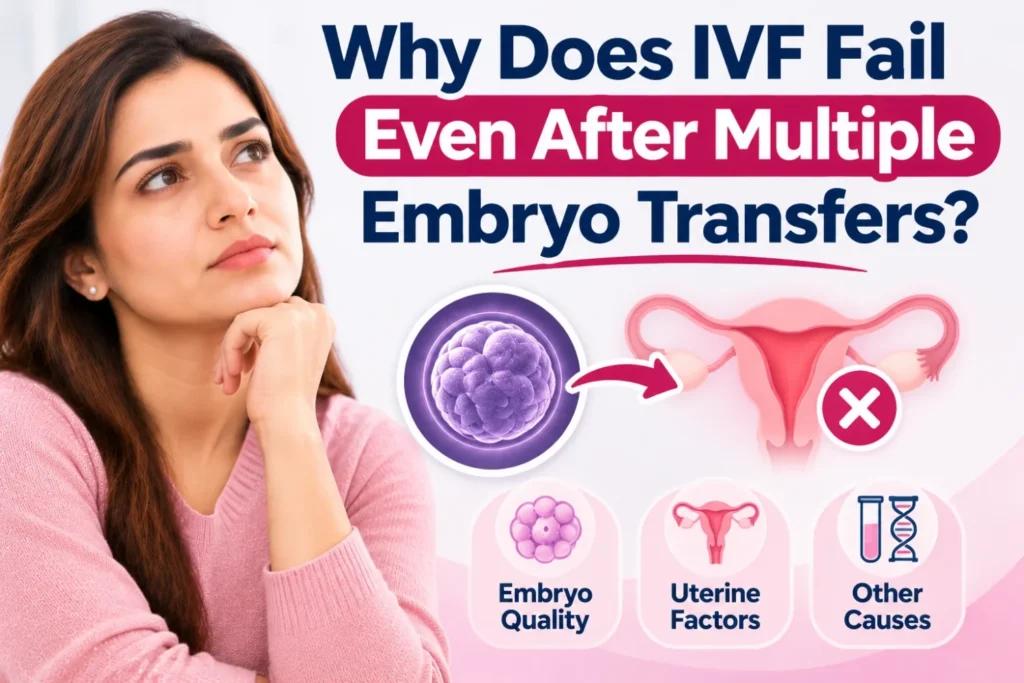
Repeated unsuccessful embryo transfers can be frustrating for patients and challenging for fertility specialists. The reason may involve embryo development, the uterine environment, or other reproductive factors.
Dr. Sophia Umair Bajwa recently attended an ASPIRE Masterclass in Bangkok, where specialists discussed one of these challenging areas of reproductive medicine.
The focus was Recurrent Implantation Failure (RIF).
What Is Recurrent Implantation Failure?
Recurrent Implantation Failure refers to repeated unsuccessful embryo transfers.
Patients may have several transfers without achieving a clinical pregnancy. But there is no single number of failed transfers that defines RIF for every patient.
The specialist considers the woman’s age, embryo characteristics, previous treatment history, and the number of embryos transferred.
This distinction matters.
One failed IVF transfer does not automatically mean you have recurrent implantation failure. Even a good-quality embryo may not implant.
Doctors need to review the complete clinical picture before reaching a conclusion.
Why Do Embryos Sometimes Fail to Implant?
Embryo implantation involves several biological processes.
The embryo needs to develop appropriately and interact with the uterine lining at the right stage. Problems affecting either side of this process may contribute to an unsuccessful transfer.
Let’s look at some factors doctors may consider.
1. Embryo quality
Embryo development and chromosomal health can influence implantation.
An embryo may look healthy under a microscope but still have chromosomal abnormalities. This can affect its ability to implant and develop.
2. Uterine conditions
The uterus provides the environment required for implantation.
Conditions such as uterine polyps, certain fibroids, and adhesions may affect the uterine cavity.
Doctors may recommend an ultrasound or other investigations when they suspect a structural problem.
3. Endometrial preparation
The endometrium is the inner lining of the uterus.
It needs appropriate hormonal preparation before embryo transfer. Doctors may review its thickness and the timing of progesterone exposure.
4. Other medical factors
Age, certain medical conditions, and previous reproductive health issues may also influence IVF outcomes.
Not every unsuccessful transfer has an identifiable cause. Sometimes, the available investigations do not reveal a clear explanation.
What Should Doctors Investigate After Repeated Failed Transfers?
Repeating embryo transfers without reviewing previous treatment records may overlook useful information.
A specialist should examine the complete IVF history.
This may include embryo grading, developmental stages, previous transfer notes, hormonal preparation, and relevant uterine investigations.
The doctor may recommend additional tests if the medical history suggests a specific problem.
For example, suspected uterine abnormalities may require further imaging or assessment.
The important point is to investigate based on clinical findings.
Patients should also be careful about expensive add-on tests and treatments that lack sufficient evidence of improving pregnancy outcomes.
More testing does not automatically mean better treatment.
What Is ASPIRE and Why Do Fertility Specialists Attend Its Masterclasses?
ASPIRE stands for Asia Pacific Initiative on Reproduction.
It brings together fertility specialists and reproductive medicine professionals from across the Asia-Pacific region.
The platform supports professional education, research discussions, and the exchange of clinical knowledge.
Dr. Sophia Umair Bajwa attended an ASPIRE Masterclass in Bangkok that focused on Recurrent Implantation Failure.
The session covered developments in fertility research from recent years and discussed ways specialists can approach challenging IVF cases.
For doctors, these learning opportunities provide a chance to review existing treatment practices and understand new research.
They also encourage discussion between specialists working in different healthcare systems.
Can New Research Change the Approach to Recurrent Implantation Failure?
Reproductive medicine continues to develop.
Researchers are studying embryo development, endometrial receptivity, implantation processes, and other factors that may influence IVF outcomes.
Some new investigations may provide additional information about specific patients.
But there is an important distinction between a promising research finding and a treatment with proven clinical benefits.
Not every new test or procedure improves the chances of pregnancy.
A fertility specialist should consider the available evidence before recommending an additional investigation or treatment.
The goal is to make decisions that fit the patient’s medical history rather than add unnecessary procedures.
Does Recurrent Implantation Failure Mean You Cannot Get Pregnant?
No.
Repeated failed embryo transfers do not automatically mean that future pregnancy is impossible.
The chances of success depend on several factors, including age, embryo characteristics, and the underlying reason for unsuccessful transfers.
After reviewing the previous cycles, the specialist may recommend changes to the treatment approach.
These could include addressing a diagnosed uterine condition, reviewing hormonal preparation, or discussing the suitability of remaining embryos.
Some patients may need further evaluation before another transfer. Others may proceed with a revised treatment plan.
There is no single solution that works for every patient.
Why Staying Updated Matters in Fertility Treatment
A challenging IVF case often requires careful review and individualised decision-making.
For fertility specialists, continuing education helps them understand new research and assess whether it has a role in patient care.
This was one of the key reasons Dr. Sophia attended the ASPIRE Masterclass in Bangkok.
She shares her experience and explains why staying updated with recent developments in reproductive medicine matters when treating patients with recurrent implantation failure.
Watch Dr. Sophia share her experience at the ASPIRE Masterclass in Bangkok.
At Family Fertility & IVF Center in Lahore, patients experiencing repeated unsuccessful embryo transfers can discuss their previous IVF reports and explore appropriate treatment options.
If you’ve experienced repeated IVF failures, what questions would you want a fertility specialist to answer? Leave a comment below or on the YouTube video. Your suggestions can help us decide which fertility topics to explore next.